
Material Handling Solutions
In-Motion & In-Line Checkweigher Solutions
Automated Weighing & Dimensioning (DIM) Systems: Addressing the Economics of Shipping
Dimensional weight, commonly known as DIM, is a calculation that combines a package’s weight and size. Beginning in 2015, shippers started charging by the greater of actual or DIM weight to reflect the space a package occupies in a truck, not just its weight.
For e-commerce and distribution operators, this represented a sharp departure from their existing practices and threatened to raise shipping costs for customers and depress sales volume. These events triggered rapid evolution in new warehouse material-handling equipment and applications for systems previously built around the uniform shape and size of corrugated boxes.
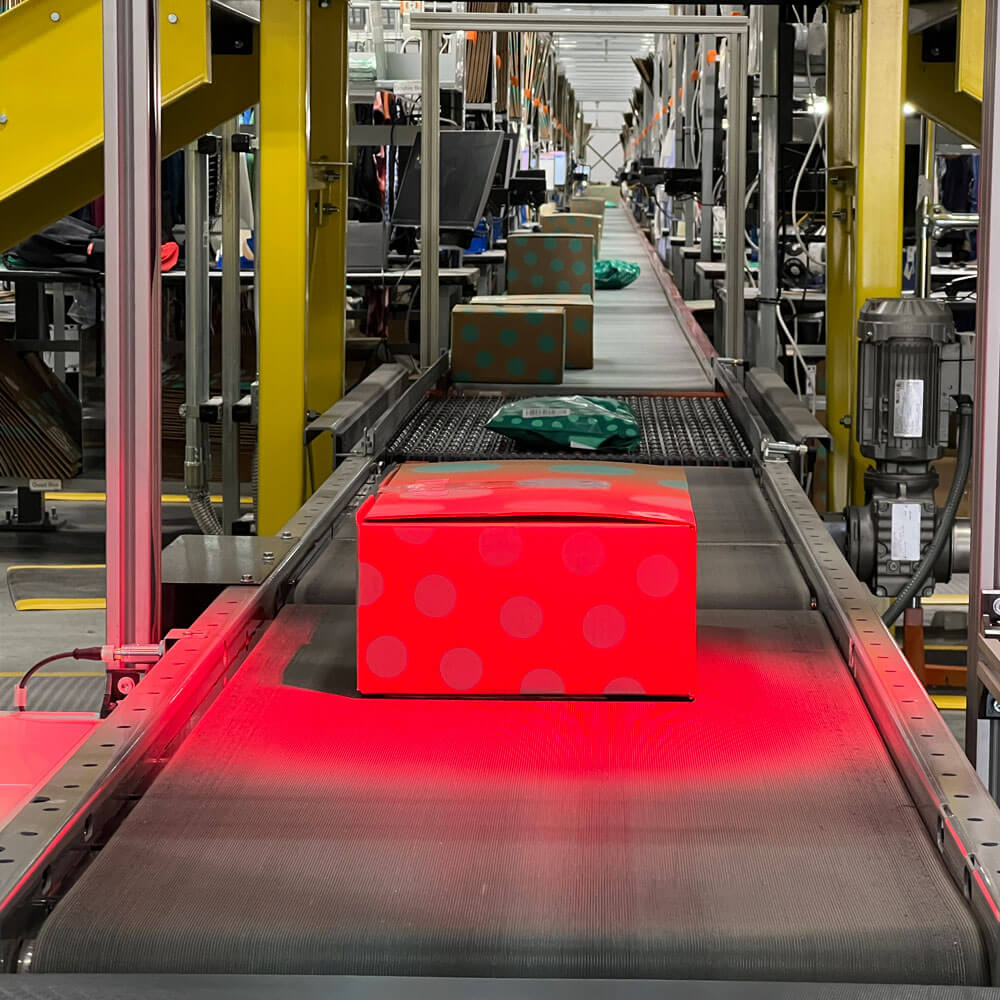
In-line scales add tremendous value to the efficiency and accuracy of shipping operations. As the package is moved through the check-weigher, the weight of the package is captured and transmitted to the WMS. Similarly, cameras and scanners capture package dimensions while in motion.
These advances provide important data for a pack-out system without negatively impacting system throughput.
Primary System Elements
Automated Weighing and Dimensioning (DIM) systems are integrated workstations or in-line modules that capture critical data necessary for accurate shipping and carrier compliance. The combined unit is often referred to as a Scan-Weigh-Dimension (SWD) system.
| Element | Function in Distribution & Fulfillment |
|---|---|
| In-Motion Scale | This high-precision check-weigher is integrated directly into the conveyor system. It uses calibrated load cells to measure the package’s weight as it moves continuously. This ensures throughput is maintained and provides accurate data for carrier billing. |
| Dimensioning Array | This hardware utilizes advanced technologies—such as laser sensors, infrared light curtains, or 3D camera vision systems—to measure the length, width, and height of the package. These devices are calibrated to measure irregular shapes, polybags, and standard cartons accurately, regardless of their orientation on the conveyor. |
| Barcode Scanner/Vision System | Located upstream of the weighing module, this device captures the package’s unique identifier (such as an LPN or case ID). This ID is the key used by the control system to link the newly captured weight and dimension data to the specific order or item within the WMS. |
| Controls Enclosure4 | Houses the Programmable Logic Controller (PLC) and interfaces that manage the sequencing of the data capture process, ensuring the weight and dimension recorded belong to the correct package as it travels through the system. |

Design and Controls Features
The power of automated dimensioning lies in its ability to translate physical measurements into actionable data that optimizes system performance and financial outcomes.
- Real-Time Data Transmission: The core feature is the ability of the SWD system to transmit the captured data immediately to the Warehouse Control System (WCS) and the WMS. This real-time communication allows the WCS to calculate the DIM weight instantaneously and select the appropriate carrier service and rate before the package reaches the shipping label application point.
- Rate Shopping Automation: By providing definitive dimensional and actual weight data, the system empowers the shipping software to perform automated “rate shopping,” selecting the most cost-effective carrier and service level for that specific package and destination.
Benefits for System Performance
Implementing an automated SWD solution delivers benefits that touch every aspect of a fulfillment or distribution center’s profitability and process integrity.
The most critical advantage is Maximized Financial Accuracy. By capturing and applying the correct DIM weight for every package, the system ensures the operator bills customers and the carrier accurately. This action eliminates revenue leakage caused by manually underestimating package size and directly protects profit margins.
Furthermore, operations see Enhanced Throughput. Because both weighing and dimensioning occur in-motion at high conveyor speeds, there is no need to stop the line for manual measuring, scaling, or data entry. This preserves the operational throughput of the entire shipping department.
The system also provides Improved Audit Capabilities. Every package is tracked and verified with a time-stamped, electronically captured record of its weight and dimensions. This audit trail is crucial for disputing carrier invoices and managing internal quality control.
Finally, organizations gain Increased Labor Efficiency. The system eliminates manual tasks associated with measuring and weighing, allowing team members to focus on exception handling, quality checks, and other value-added activities.
- Pack-Out Optimization Integration: Data captured by the dimensioning system can feed back into upstream processes to optimize packaging choices. For instance, if a dimensioner identifies excessive void space in a packed carton, the data can flag the order for audit or prompt the WMS to select a right-sized carton for future similar orders.
- Compliance Verification: The system serves as a financial safeguard, ensuring that internal billing data aligns with the carrier’s final charges, drastically reducing invoice discrepancies and costly chargebacks for undeclared or inaccurate package sizes.
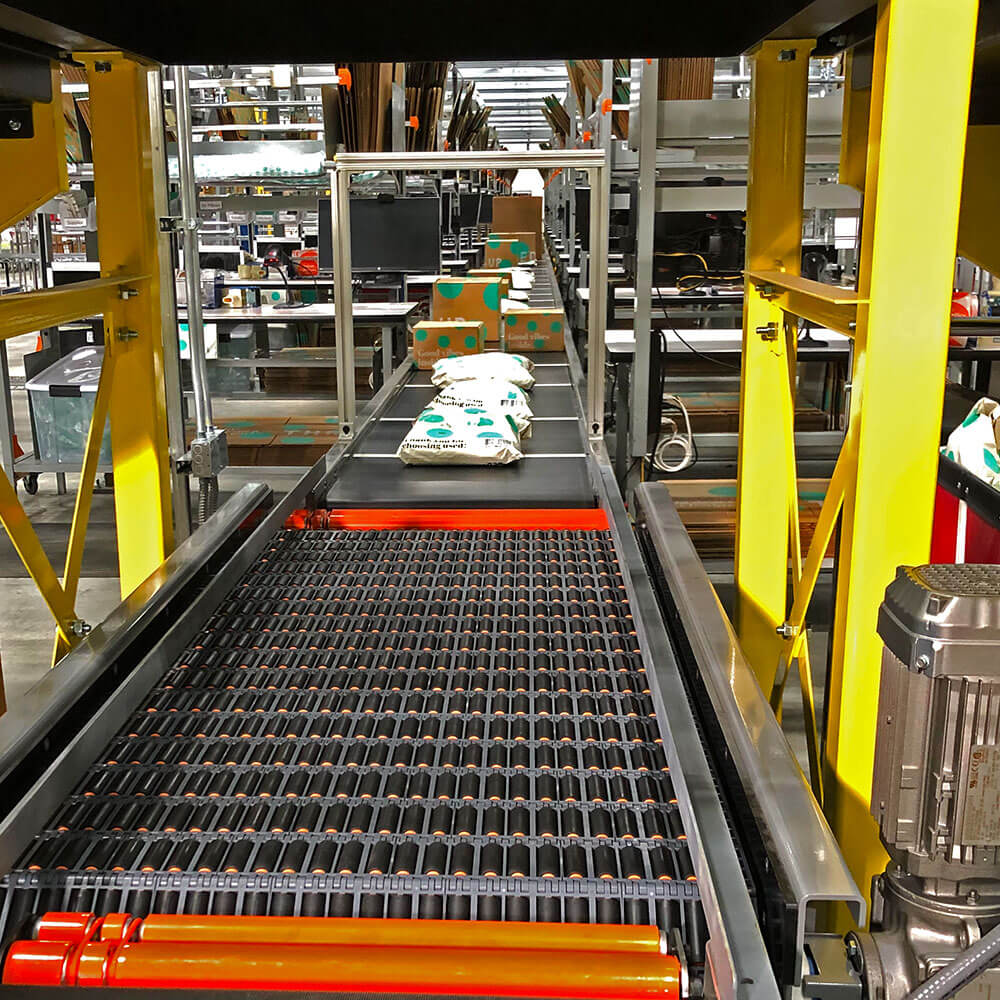
The advent of DIM also spurred the necessity to minimize package size in order to control shipping costs. As a result, polybags have become a standard shipping package.
The result is that pack-out systems must now accommodate a variety of carton sizes mixed with polybags. In turn, material handling systems have evolved to effectively manage the variety of objects being moved and processed.
Cameras have become a key aspect of conveyor system design, allowing the WCS to accurately assess every package as it passes through the system. This information allows downstream peripheral technologies to be prepared to adapt for each package: robotic end-of-arm tools, printing, and labeling.
Don’t be fooled. Warehouse control systems are more than just software.
SilMan’s Unison is a single solution that unites equipment and material handling processes to build a seamless interface with WMS platforms.
Unison harmonizes every element of warehouse operations: sortation control, data collection, diagnostics, software, and programming.
A controls systems are only as good as the controls team who installed and programmed it. SilMan’s veteran in-house control group is an integral part of our integration team and a key aspect of SilMan’s success.
About the Company
SilMan Industries (previously SilMan Construction) is based in San Leandro, Calif., with Engineering and Field Operations offices in Tupelo, Miss. The firm provides integrated turnkey solutions in the Industrial, Manufacturing, Distribution, and Public Works sectors.
Notably, in 2010 SilMan Industries was contracted to dismantle and remove the NUMMI assembly line in Fremont, Calif., transport the equipment, and reinstall the system in Blue Spring, Miss., establishing Toyota Motor Manufacturing Mississippi (TMMMS). This high-visibility project ignited the company’s meteoric growth, laying the foundation for SilMan’s national service area.
For more information, please visit www.silmanindustries.com/about.

Frequently Asked Questions for Weight & Dimension
What is a scan-weigh-dimension (SWD) system and how does it work?
A scan-weigh-dimension (SWD) system is an automated in-line solution that captures a package's unique ID, actual weight, and physical dimensions while the package is in motion. The system uses a combination of barcode scanners, calibrated load cells (in-motion scales), laser sensors, infrared light curtains, and 3D camera vision systems to transmit real-time data to a Warehouse Management System (WMS).
Why is dimensional weight (DIM) important in warehouse automation?
Dimensional weight (DIM) is critical because carriers charge based on the space a package occupies (length x width x height), not just its physical weight. DIM ensures fair billing for bulky but lightweight items and prevents revenue leakage due to manual errors. DIM also allows for automated rate shopping between different carriers to find the most cost-effective shipping method.
Can automated checkweighers handle both polybags and standard cartons?
Yes, modern automated checkweighers and dimensioning arrays are designed to process a mix of polybags and cartons on the same line. Advanced 3D cameras, laser sensors, and infrared light curtains can accurately measure irregular shapes and polybags regardless of their orientation on the conveyor, ensuring continuous throughput. Speed, efficiency, and accuracy are greatly enhanced compared to manual sorting.
