
Material Handling Solutions
Automated Robotic Palletizing Systems
Palletizing robots are a widely deployed end-of-line solution that can add speed and accuracy to warehouse operations.
There are two primary methods by which automated robotic palletizing systems operate. First, individual containers are picked from a conveyor and placed directly onto a pallet by a robot.
Another method is to incorporate two separate robots. One creates layers of cartons by picking or sliding cartons onto a base layer (such as plywood) and arranging them into a pre-programmed pattern. The second robot lifts the entire layer and places it onto a pallet.
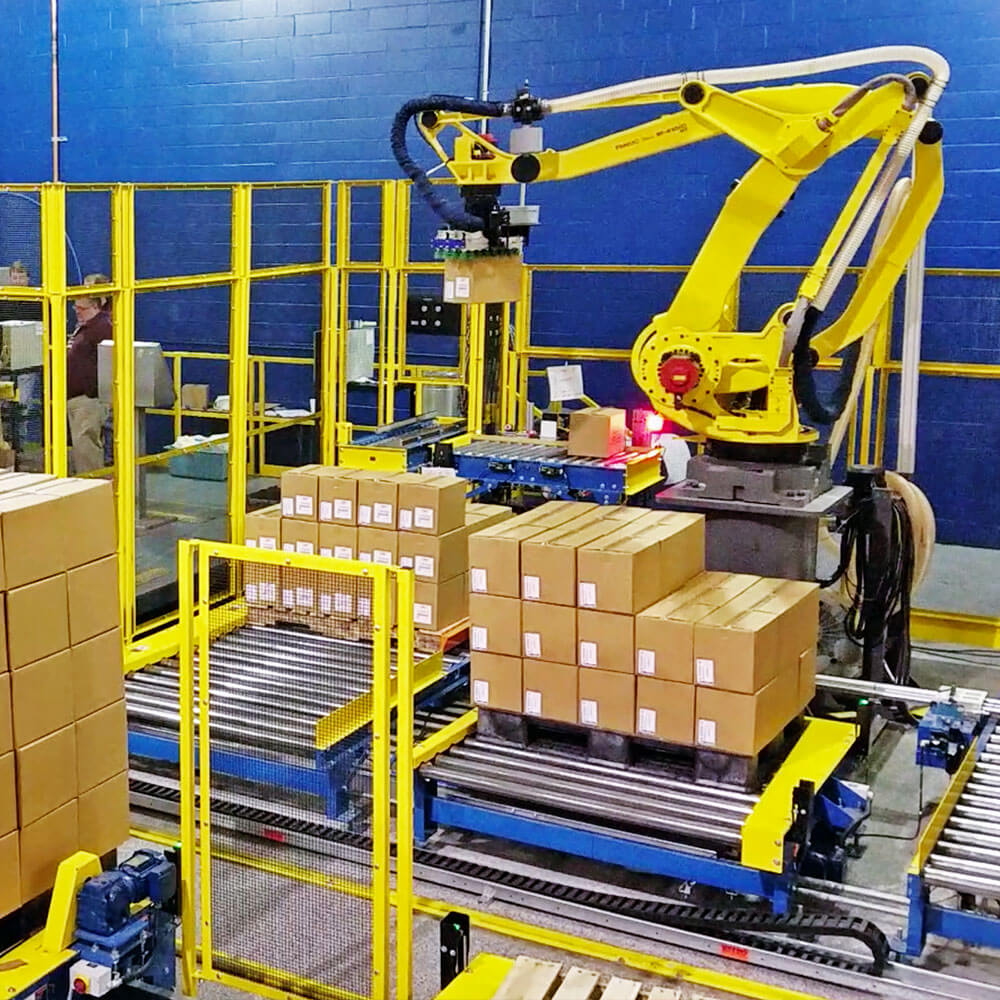
Photo-eyes identify the carton size, type, and contents as they arrive in the palletizing area. These cameras guide the robots regarding location, position, and orientation as they approach the palletizing station, as well as signaling real-time modifications to the end-of-arm tool for varying package dimensions when programmed for multiple package types.
Further automation can occur in the palletizing area, such as the use of a pallet conveyor, chain transfers, or turntables that move completed pallets to the shipping area, eliminating the need for a forklift operator.
Core System Elements and Design Features
An effective robotic palletizing cell is a carefully integrated system of conveyance, vision, and motion control, engineered to handle continuous high-volume output from upstream sorters or packaging lines.
| Element | Role in Palletizing Automation |
|---|---|
| Robotic Arm | The core motion component, typically a 4- or 6-axis articulated arm or gantry-style robot, is chosen based on required speed, payload capacity, and reach. |
| End-of-Arm Tooling (EOAT) | The customized gripper or head that interfaces with the product. Tools include vacuum suction cups (for smooth cartons), side clamps (for stability), or fork-style grippers (for heavy layers). |
| Infeed Conveyance | High-speed conveyors and singulators that space and orient cartons, ensuring they arrive at the robot’s pick-up zone at a consistent and predictable interval. |
| Pallet Dispenser | An automated unit that stages empty pallets, feeding them onto the pallet conveyor without human intervention to maintain a continuous process flow. |
Advanced Design and Controls Features
The intelligence and flexibility of a robotic palletizing system lie in its software and ability to handle complexity:
- Mixed-Case Palletizing: A sophisticated design feature for fulfillment centers that handle high-volume, less-than-truckload (LTL) orders. The system uses advanced software to calculate the optimal mixed-SKU layer pattern (stacking cases of varying sizes and weights) to build a stable, cube-efficient pallet for shipping.
- Vision Systems and Sensors: High-resolution sensors are integrated with the robot’s control platform, providing real-time dimensional scanning of every inbound carton. This allows the robot to make micro-adjustments to its placement path and to confirm that the pallet is being built according to the planned pattern and height.
- Safety and Containment: Each robotic cell is enclosed with comprehensive safety guarding, interlocked gates, and light curtains to meet operational safety standards, ensuring personnel cannot enter the robot’s working envelope while operational.
Benefits for Distribution and Fulfillment Centers
Implementing automated palletizing is a key strategic decision that offers far-reaching operational advantages beyond simple labor replacement.
Maximizing Efficiency and Stability
Robotic palletizing is instrumental in enhancing the throughput and stability of the entire supply chain:
- Enhanced Throughput and Speed: Robots operate continuously and at speeds that far exceed manual labor, ensuring that downstream processes can keep pace with high-speed upstream sortation and packaging machinery, preventing bottlenecks at the end-of-line.
- Optimal Cube Utilization: Automated systems are programmed to build pallets with high precision, maximizing the density of goods loaded onto each pallet. This reduces shipping costs by minimizing empty space (void fill) and allows for the loading of more product per trailer.
- Improved Product Stability and Integrity: By utilizing pre-programmed patterns and consistent force application, robots build more uniform and structurally sound pallets. This reduces shifting and product damage during transit, minimizing customer returns and claims.
Labor and Ergonomic Advantages
The adoption of palletizing robots addresses significant challenges related to workforce management and safety:
- Ergonomics and Safety: Palletizing is one of the most repetitive and physically demanding tasks in a warehouse, frequently resulting in high rates of fatigue and injury. Shifting this strenuous activity to a robot improves team member ergonomics, reduces compensation claims, and frees human labor for less strenuous, higher-value tasks, such as system monitoring and quality control.
- Predictable Performance: Unlike manual labor, robots do not fatigue or require breaks. They ensure consistent, 24/7 productivity, making labor forecasting and production planning significantly more reliable.
It goes without saying that the implementation of a robotic palletizing system will increase the speed and efficiency of your operation.
Moreover, robots in palletizing offer an incredible increase in team member safety. Repetitive lifting and turning are hazardous to workers, which can lead to production delays and financial loss related to workplace injuries.
But these improvements do not come without complications that influence whether or not the adoption of robotics is justified.
The first is volume. However, even with lower levels of throughput, an investment in robotics may remain justified simply by the reduction of safety-related costs.
Secondly, don’t overlook the cost of repair and service. While robotic systems increase throughput, time and funding must be allocated to keep these amazing machines operating at their best.
Robots are not a standalone solution. In fact, they are powerless on their own.
When it comes to robotic solutions, the power is in the package.
And just like all other high-tech solutions, the decision to implement new technology lies in understanding your current operation and a clear vision for your facility as a whole.
That is where your integrator-partner can provide the most value to you.
Want to learn more about robotic integration? Here is an article created to clarify terminology and uses in robotic systems.
About the Company
SilMan Industries (previously SilMan Construction) is based in San Leandro, Calif., with Engineering and Field Operations offices in Tupelo, Miss. The firm provides integrated turnkey solutions in the Industrial, Manufacturing, Distribution, and Public Works sectors.
Notably, in 2010 SilMan Industries was contracted to dismantle and remove the NUMMI assembly line in Fremont, Calif., transport the equipment, and reinstall the system in Blue Spring, Miss., establishing Toyota Motor Manufacturing Mississippi (TMMMS). This high-visibility project ignited the company’s meteoric growth, laying the foundation for SilMan’s national service area.
For more information, please visit www.silmanindustries.com/about.

Frequently Asked Questions for Automated Palletizing Systems
What is an automated palletizing system?
An automated palletizing system uses robotic arms, conveyors, and smart software to stack cartons, cases, or totes onto pallets at high speed. Well-designed systems carefully integrate conveyance, vision, and motion control and are capable of handling continuous high-volume output from upstream sorters or packaging lines. Automated palletizing solutions can be designed to handle single-SKU or mixed-case loads, dramatically increasing throughput while reducing manual labor in manufacturing, distribution, and fulfillment centers.
What is the difference between a robotic palletizer and a conventional palletizer?
The main difference is flexibility and footprint. Robotic palletizers utilize an articulated arm to handle a range of package and container types, complex stacking patterns, and mixed-case pallets in a compact space. Conventional palletizers are typically larger, high-speed machines that use a layer-forming process, making them better suited for high-volume runs of a single product type.
How do palletizing robots handle different box sizes on the same pallet?
Palletizing robots handle multiple box sizes using mixed-case palletizing software and advanced vision systems. Inbound cartons are scanned to identify dimensions, while the software calculates the most stable and space-efficient stacking pattern. The robot's End-of-Arm Tooling (EOAT), such as vacuum grippers or adjustable clamps, allows it to securely pick and place varying package types while the line continues to run.
What are the primary safety requirements for a robotic palletizing cell?
A robotic palletizing cell must incorporate comprehensive safety guarding such as physical fencing, light curtains, and interlocked gates. These features keep workers safely outside the system during operation. Systems should comply with ANSI/RIA R15.06 industrial robot safety standards, often featuring "Safety-Rated Soft Axis" and "Space Limiting" technology to ensure the robot stays within its designated working envelope.
