
Material Handling Solutions
Automatic Packaging System: Print and Apply Systems
The automation of labeling is a pivotal strategic element for any high-volume distribution or fulfillment center. Print and Apply (or “P&A”) broadly refers to the process of labeling packages within material handling systems.
In both cases, highly specialized equipment has been developed to execute these processes as packages are transported by conveyor. Further advances in this equipment category allow the labeling of multiple package types in a single conveyor system. See the featured case study below.
Printing and application processes are aided by cameras and scanners. These devices detect the location and position on the conveyor, as well as the package type to ensure the label is properly printed or affixed.
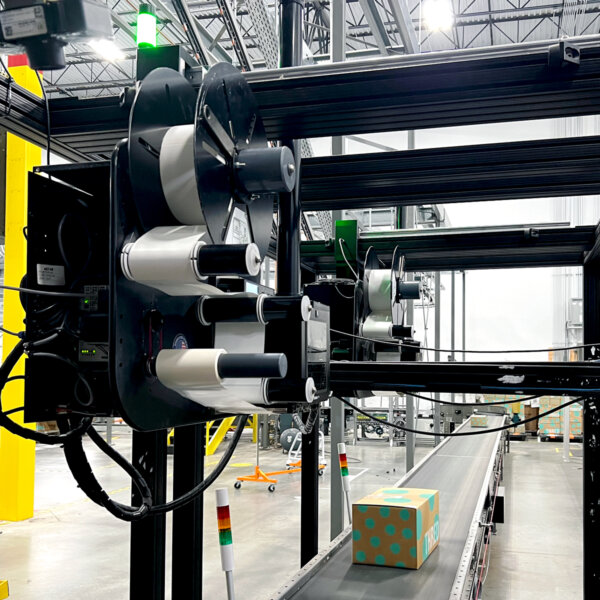
The information imprinted may include location, routing, or shipping details, and will often identify the contents of the package in the form of a bar code.
Package and labeling activity is transmitted to and from the WMS via the warehouse control system, which directs the print and application equipment.
The explosion of P&A applications is closely related to e-commerce and dimensional weight shipping, which have caused a dramatic increase in the number of labels needed. In fact, a new industry group has been formed around these challenges.
The Value Proposition of Automated P&A
The strategic implementation of a well-conceived P&A system transforms labeling from a manual, error-prone task into a seamless, high-speed automated process. A robust system directly translates operational efficiency into competitive advantage by ensuring every package is accurately identified and routed.
Benefits for Fulfillment Operations
Automated P&A solutions deliver a direct and measurable impact on critical fulfillment metrics, providing a rapid return on investment (ROI):
- Increased Throughput and Efficiency: By eliminating the time-consuming manual steps of printing, peeling, and hand-applying labels, the system maintains a consistent pace that matches high-speed conveyors and sortation equipment. This high-speed capability prevents bottlenecks at crucial process points.
- Enhanced Accuracy and Traceability: Automation eliminates the human errors associated with manual labeling, guaranteeing the right label is on the right package every time. The verified, unique barcode provides a reliable data point for real-time tracking throughout the internal process and the entire carrier network.
- Reduced Operational Costs: Labor is reallocated from repetitive labeling tasks to higher-value activities. Furthermore, accurate labeling minimizes mis-ships, avoids costly carrier fees, and reduces financial penalties associated with retail chargebacks for non-compliant labels.
- Streamlined Reverse Logistics: Advanced systems can automate the application of both a final shipping label and an integrated pack slip/return label simultaneously, which improves the efficiency of both outbound shipping and the processing of returns.

Core System Elements and Equipment
A P&A solution is an integrated unit built for automated, on-demand labeling. Optimal performance depends on the precise harmonization of its primary elements:
| System Element | Function in a Fulfillment Center |
|---|---|
| Print Engine/Module: | The mechanical arm or module that physically applies the label. Techniques include: Tamp-Apply (for inconsistent package heights), Wipe-On/Merge (for high-speed, uniform flow), and Blow-On (for delicate packages). |
| Conveyance & Gapping: | Aligned conveyor sections that utilize precision mechanics to ensure products are correctly spaced (gapped) and justified to one side, which guarantees consistent label placement. |
| CPre/Post Scanners | Upstream scanners read the initial package ID (LPN/case ID) to retrieve the correct shipping data. Downstream scanners verify the readability of the newly applied label, triggering a reject mechanism if necessary. |
Advanced Design and Control Features
The intelligence of a P&A system is found in its sophisticated control features, allowing it to function seamlessly within dynamic, high-volume operations:
- Variable Data Handling: The system can print unique, sequential data on every label, including serial numbers, lot codes, time stamps, and unique carrier tracking numbers derived from the WMS/WCS. This is critical for generating GS1-128 compliance barcodes and other retailer-mandated formats.
- WMS/WCS Integration: The system is seamlessly connected to the enterprise systems. The Warehouse Control System (WCS) acts as the communication layer, retrieving the correct manifest data from the WMS based on the package scan, and then sending the precise print file to the P&A unit.
- Application Versatility: Modern design allows for specialized application methods to handle diverse packaging, including:
- Corner-Wrap Applicators: Place a single label across two adjacent panels, maximizing label visibility and scannability, regardless of package orientation on the sortation conveyor.
- Auto-Height Sensors: Enable the tamp arm to automatically adjust its extension for packages of highly variable heights traveling in line, ensuring precise placement without slowing down the line.
The integration of these features ensures a robust, reliable, and future-proof labeling process, protecting the operation’s throughput capacity and supporting scalable growth.
Connectivity with warehouse control and warehouse management system is essential to the successful integration of print and apply peripherals into a material handling operation.
Inbound packages can be labeled during induction which will communicate the routing, special handling instructions, and inventory location for the carton.
Shipping operations, contents, customer accounts, and shipping locations are also managed by the WMS and WCS to ensure that outbound packages are properly labeled and interfaced with shipping systems or third-party delivery services.
Furthermore, in manufacturing settings, components can be labeled when produced or inducted. This serial number is a permanent record of the part and its performance and can be tracked for quality control.
All of this tracking, mechanical actuation, and data collection is a function of the WMS and WCS capabilities of the facility.
Don’t be fooled. Warehouse control systems are more than just software.
SilMan’s Unison is a single solution that unites equipment and material handling processes to build a seamless interface with WMS platforms.
Unison harmonizes every element of warehouse operations: sortation control, data collection, diagnostics, software, and programming.
Controls systems are only as good as the controls team who installed and programmed it. SilMan’s veteran in-house control group is an integral part of our integration team and a key aspect of SilMan’s success.
About the Company
SilMan Industries (previously SilMan Construction) is based in San Leandro, Calif., with Engineering and Field Operations offices in Tupelo, Miss. The firm provides integrated turnkey solutions in the Industrial, Manufacturing, Distribution, and Public Works sectors.
Notably, in 2010 SilMan Industries was contracted to dismantle and remove the NUMMI assembly line in Fremont, Calif., transport the equipment, and reinstall the system in Blue Spring, Miss., establishing Toyota Motor Manufacturing Mississippi (TMMMS). This high-visibility project ignited the company’s meteoric growth, laying the foundation for SilMan’s national service area.
For more information, please visit www.silmanindustries.com/about.

Frequently Asked Questions for Print and Apply
What is a print and apply labeling system?
A print and apply labeling system is an automated solution that prints variable data—such as barcodes, shipping information, serial numbers, and GS1-128 compliant labels—in real time and immediately applies them to packages, cartons, or pallets on a conveyor. The print and apply system eliminates manual labeling and increases speed and efficiency in high-volume distribution and fulfillment operations.
What is the difference between tamp-apply and wipe-on/merge print and apply systems?
The primary difference lies in how the label is delivered. Tamp-apply systems use a mechanical arm to press labels onto packages of varying heights, making them ideal for mixed-sized cartons. Wipe-on (or merge) systems apply labels as the package moves past at high speeds, which is best for uniform packaging and high-volume throughput. A further application option is Blow-on, which can be used for delicate items.
How does a Print and Apply (P&A) system integrate with a Warehouse Management System?
Print and Apply systems integrate with a Warehouse Management System (WMS) through a Warehouse Control System (WCS). The WCS acts as a communication bridge, upstream scanners acquire the package's initial ID (LPN), retrieving the specific shipping or manifest data from the WMS, and sending the correct print file to the applicator in real-time.
What are the benefits of automated labeling in fulfillment centers?
Automated labeling, or Print and Apply, increases fulfillment efficiency by eliminating manual errors and bottlenecks. Key benefits include increased throughput, enhanced tracking accuracy for carrier networks, streamlined reverse logistics (for easier returns), and reduced operational costs by reallocating labor from repetitive tasks to higher-value activities.
