
Material Handling Solutions
Automation for Manufacturing Conveyor Systems
Material handling is a central aspect of manufacturing or assembly operations. Most of the movement of components is accomplished by automated conveyor systems. The process for any given assembled product includes specialized equipment and tooling that perform a specific application.
These diverse operations are organized into a progression that produces a finished product. Along the way, there are human and mechanical interactions for each station, technology, or process.
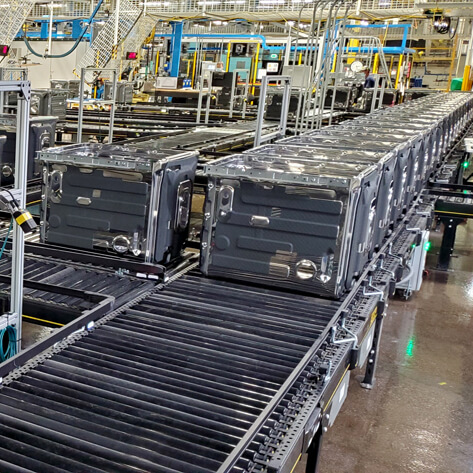
Each of these operations is connected by a material handling system designed for each unique circumstance. It is not a stretch to say that material handling systems provide the efficiencies that make mass production cost-effective.
Picking and placing is another material handling task at these stations, often executed by robots.
Manufacturing operations for large items (i.e.: automobiles) and small items (i.e.: electronic components) all benefit from the automated movement of materials through the facility.
In addition to productivity, material handling solutions improve team member ergonomics by shifting activities such as turning, lifting, and carrying to mechanical equipment.
Engineered Flow: The Foundation of Modern Assembly
A precisely engineered material handling system serves as the backbone and pacing mechanism for any manufacturing or assembly line. The true value of this automation lies in achieving consistent, repeatable movement that reduces work-in-progress (WIP) and ensures reliable cycle times at every station.
Enhancing Performance and Control
The continuous, synchronized movement achieved through automated conveyance offers several critical benefits to plant management:
- Improved Quality Control: By delivering parts to stations with exact timing and positioning, conveyance systems eliminate process variance, which is a key driver of manufacturing defects. This precision supports higher quality output and reduced scrap rates.
- Optimal Space Utilization: Specialized material handling, including overhead monorails, power and free systems, and floor conveyors, allows parts and finished goods to travel vertically or through otherwise inaccessible areas. This strategic flow maximizes usable floor space for production activity.
- Synchronization and Pacing: Conveyors act as a controlled metronome for the assembly process. They ensure that all upstream and downstream operations remain balanced, preventing costly accumulation zones and bottlenecks that disrupt line efficiency.


Specialized Conveyor Equipment for Manufacturing
The selection of equipment in manufacturing is highly specific, often requiring specialized technology to integrate with precise robotic and tooling applications:
| Equipment Type | Primary Use in Manufacturing |
|---|---|
| Slat Conveyors | Assembly lines for large, heavy products (e.g., engines, machinery). Provides a flat, stable surface for workers or robots to interface with the product. |
| Power and Free (P&F) | Body-in-white and paint shop operations in automotive. Allows products (carriers) to be indexed, stopped, and routed independently, offering maximum routing flexibility. |
| Skillet/Platform Systems | Ergonomic and high-precision assembly. Platforms lift and lower the product for optimal access by workers or robots, while providing power access. |
| Overhead Monorails | Transporting component parts to the assembly line from storage or sequencing areas. Efficiently utilizes ceiling space to free up floor access. |
Integration with Automation and Robotics
Modern material handling is incomplete without its integration into advanced automation. SilMan’s Controls and Engineering Teams design conveyor systems that seamlessly handshake with robots, providing accurate and repeatable positioning for automated welding, painting, inspection, and high-speed picking and placing. The central control platform governs connectivity to ensure that components are precisely located and oriented for the robot. By expertly managing this critical interface, SilMan minimizes cycle time and maximizes the precision that defines world-class manufacturing, delivering a fully synchronized production line.
The tools used by the SilMan Integration Team include mechanical and electrical engineering, as well as 3D CAD drawings.
Statistical analysis of rate and volume for the current and future system provides valuable information, which in turn drives the determination of the scope and kinds of equipment needed.
But the most important ingredient to a successful outcome is relationship and trust. It is essential that the integrator possesses a thorough understanding of the system owner’s financial and operational objectives, as well as the company’s culture.
And, of course, the client must feel secure in the knowledge and experience of the solutions proposed by the integrator.
SilMan’s in-house engineering team includes mechanical, electrical, structural, and controls engineers. This tightly-knit team is at the heart of our integration services, providing clarity and responsiveness throughout the design phase.
Moreover, our high-touch approach is supported by a cloud-based, real-time project management platform, which provides the status of your project on your mobile phone 24 hours a day.
About the Company
SilMan Industries (previously SilMan Construction) is based in San Leandro, Calif., with Engineering and Field Operations offices in Tupelo, Miss. The firm provides integrated turnkey solutions in the Industrial, Manufacturing, Distribution, and Public Works sectors.
Notably, in 2010 SilMan Industries was contracted to dismantle and remove the NUMMI assembly line in Fremont, Calif., transport the equipment, and reinstall the system in Blue Spring, Miss., establishing Toyota Motor Manufacturing Mississippi (TMMMS). This high-visibility project ignited the company’s meteoric growth, laying the foundation for SilMan’s national service area.
For more information, please visit www.silmanindustries.com/about.

Frequently Asked Questions for Automated Manufacturing Conveyor Systems
What are the different types of manufacturing conveyor systems?
Common types of manufacturing conveyors include slat conveyors for heavy machinery assembly, power and free (P&F) systems for automotive assembly and paint shop operations, overhead monorails for component transport using ceiling space, and skillet/platform systems for high-precision ergonomic assembly.
How does an automated conveyor system improve manufacturing efficiency?
Automated conveyors improve efficiency by synchronizing operations and providing consistent pacing for the assembly line, ensuring upstream and downstream operations maintain balance. They reduce work-in-progress (WIP) bottlenecks, eliminate process variance to improve quality control, and enhance safety and ergonomics by automating heavy lifting tasks.
How do conveyors integrate with industrial robotics and automation?
Modern conveyors integrate with robotics through advanced control platforms that provide for a seamless "handshake" between the conveyor and the robot. Precise, repeatable positioning is achieved, allowing for high-speed automated welding, painting, inspection, and picking-and-placing. The result is minimized cycle times and maximized production precision.
What benefits do automated material handling solutions offer in manufacturing?
The benefits of automated solutions include enhanced worker safety due to reduced manual lifting, increased speed and precision for faster turnaround and quality control, and reliable cycle times. They integrate seamlessly with robotics for tasks like high-precision welding, painting, and inspection. Ultimately, automated material handling solutions result in cost savings and higher operational control.
