
Material Handing Solutions
Automated Shipping Systems: The Final Mile of Fulfillment
From Pack-Out to Carrier Compliance
The shipping department represents the final critical process within the fulfillment center, where inventory control ends and carrier logistics begin. An optimized shipping system is crucial for controlling outbound costs, maintaining consistent customer service levels, and ensuring carrier compliance. It is the last opportunity to verify order accuracy and secure the highest possible freight savings.
Modern shipping systems are highly integrated solutions that automate weighing, manifesting, labeling, and sortation. By adopting best practices across the industry, these systems convert packed cartons into fully compliant, ready-to-ship freight.
A complete system addresses challenges such as fluctuating dimensional weight (DIM) charges, managing multiple carrier services, and achieving high-speed sortation to specific outbound trailers. Strategic integration ensures the facility captures all necessary data and completes all required paperwork before the package leaves the dock door.
Core System Elements and Equipment
Shipping system design includes high-speed data capture and precision routing equipment, integrated to create a continuous product flow.
| Equipment Category | Role in Outbound Shipping Automation |
|---|---|
| Scan-Weigh-Dimension (SWD) Systems | Critical for cost control. Captures package ID, actual weight, and dimensions (DIM) in-motion, linking precise data to the order for manifesting and carrier billing. |
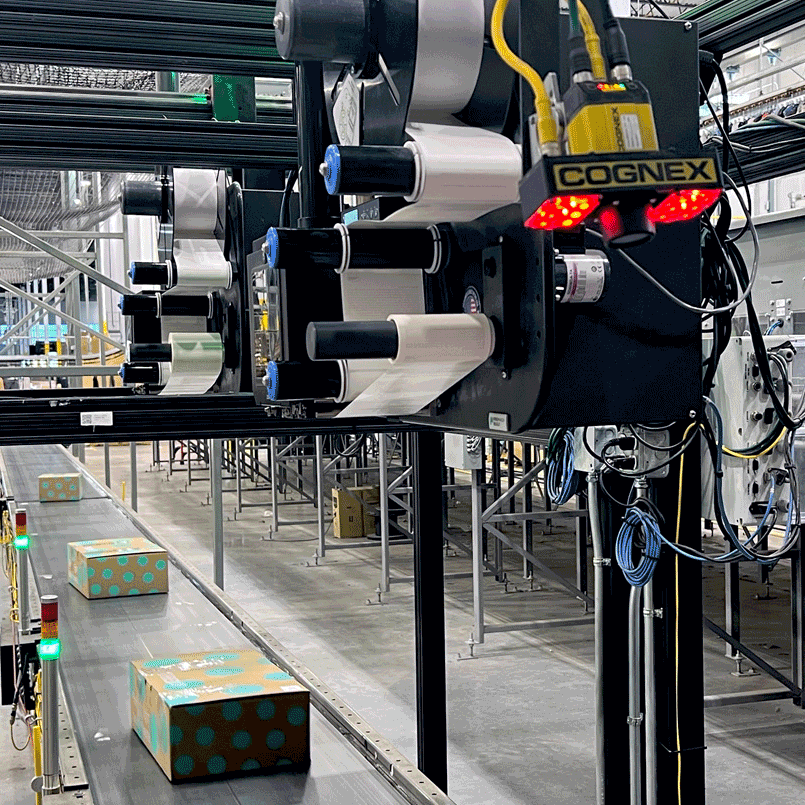
| Print and Apply (P&A) Labelers | Applies the final shipping label, often containing carrier-specific barcodes, tracking numbers, and routing information. Must operate at the same speed as the conveyor line. |
| Manifesting Software | The application layer that communicates with multiple carriers (e.g., FedEx, UPS, USPS). It uses the SWD data to perform rate shopping and generate the official shipping manifest and tracking label. |
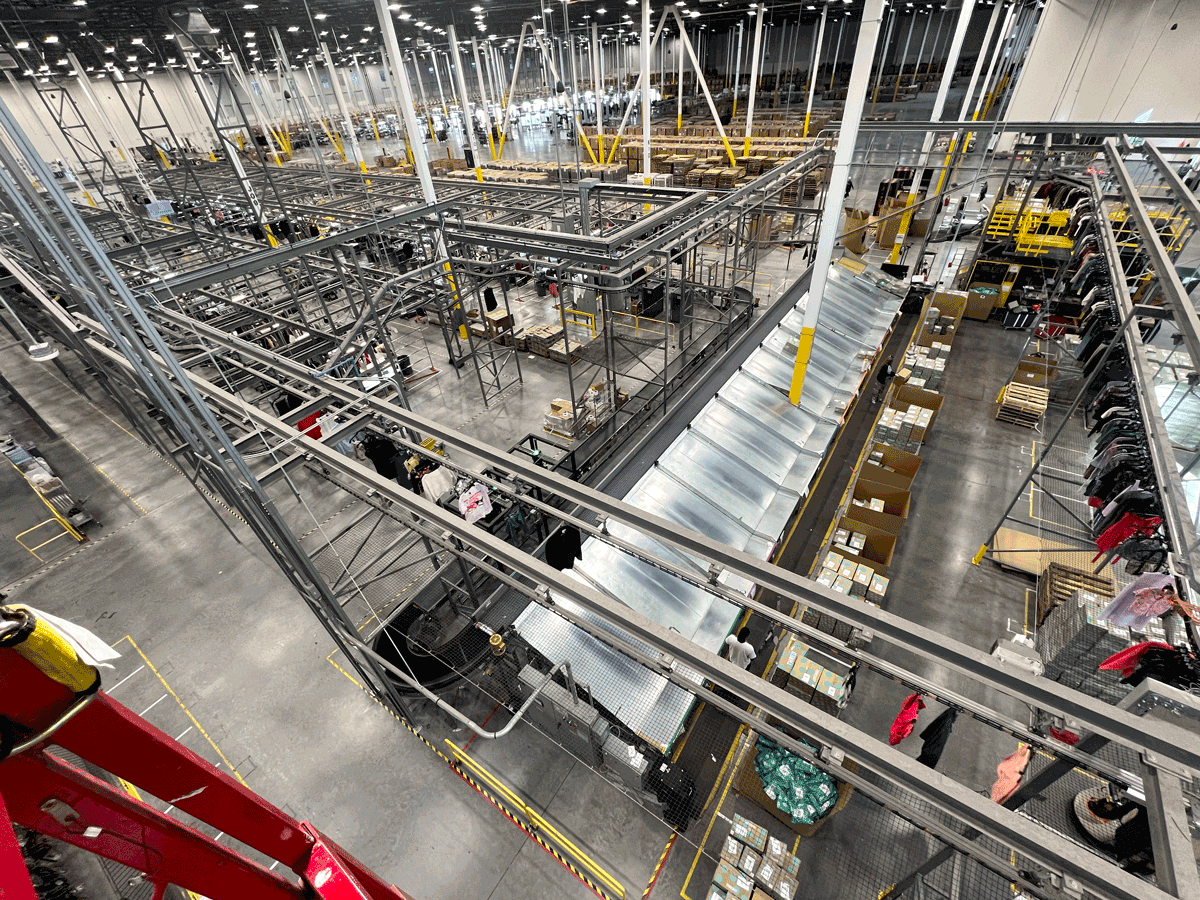
| High-Speed Sortation Systems | Equipment like Shoe Sorters, Cross-Belt Sorters, or Pop-Up Wheel Sorters used to divert packages to the correct outbound lane based on the printed label’s data. |
| Outbound Conveyance | Lanes of conveyor dedicated to accumulating packages before loading. Often ends in Telescopic Conveyors that extend into the trailer for efficient, ergonomic loading. |
Design and Controls Features for Compliance
The Controls architecture of a shipping system must prioritize accuracy and dynamic decision-making to minimize errors and financial risk. SilMan's in-house Controls Group ensures this level of precision and seamless integration with the WMS.
Carrier Rate Shopping Logic: The Warehouse Control System (WCS) is designed to instantaneously calculate the total cost for each package across all active carriers and service levels, selecting the most cost-effective option based on weight, dimensions, and delivery time requirements, which are the primary drivers of freight cost savings.
Pre-Sort Inspection and Quality Control: A critical best practice where machine vision cameras and scanners identify flawed cartons—such as crushed, leaking, or incorrectly labeled boxes—and automatically diverts them. This data ensures that only shipment-ready, structurally sound cartons reach high-speed sortation, eliminating stoppages and improving palletizing operations.
Post-Application Verification (Read & Reject): A crucial QC feature where a secondary scanner reads the newly applied shipping label. If the label is illegible, incorrect, or misapplied, the package is immediately diverted to a reject/audit lane for manual correction, preventing mis-ships and potential carrier fines.
System Integration with ERP/WMS: The shipping system must provide seamless, real-time feedback to higher-level systems, ensuring immediate updates to the WMS and ERP with the shipped status, final tracking number, and freight costs for the order.
Benefits for Profitability and Service Levels
Implementing a highly automated and integrated shipping system yields profound benefits, transforming a traditionally manual, high-cost area into a profit-protected operation.
| Optimized Freight Spend | Automated DIM capture and rate shopping ensure the facility never overpays for shipping, directly protecting profit margins. |
|---|---|
| Guaranteed Carrier Compliance | Automated verification and manifesting drastically reduce costly fines, penalties, and unexpected charges resulting from non-compliant freight. |
| Increased Throughput and Speed | Automating data capture (SWD) and labeling in-motion prevents bottlenecks at the dock, ensuring all carrier cut-off times are reliably met. |
| Enhanced Traceability | Every package leaves the facility with an electronically verified record, providing an unbreakable audit trail necessary for disputing carrier invoices and proving order accuracy. |
| Improved Labor Efficiency | Eliminating manual weighing and measuring frees personnel to focus on high-value tasks, improving overall labor utilization, and addressing ergonomic concerns. |
The SilMan Advantage: Turnkey System Integration
For complex end-of-line systems, choosing the right equipment is only the first step. SilMan Industries provides an integrated, turnkey solution. Our "One Team" approach—combining in-house Engineering, the UNISON WCS Controls Group, and veteran Installation Teams—guarantees superior project execution.
We ensure that all material handling processes, software logic, and equipment are synchronized for peak performance, delivering ROI-justified results and preparing your facility for the next generation of parcel handling challenges.
About the Company
SilMan Industries (previously SilMan Construction) is based in San Leandro, Calif., with Engineering and Field Operations offices in Tupelo, Miss. The firm provides integrated turnkey solutions in the Industrial, Manufacturing, Distribution, and Public Works sectors.
Notably, in 2010 SilMan Industries was contracted to dismantle and remove the NUMMI assembly line in Fremont, Calif., transport the equipment, and reinstall the system in Blue Spring, Miss., establishing Toyota Motor Manufacturing Mississippi (TMMMS). This high-visibility project ignited the company’s meteoric growth, laying the foundation for SilMan's national service area.
For more information, please visit www.silmanindustries.com/about.

Frequently Asked Questions for Automated Shipping Systems
What are automated shipping systems?
Automated shipping systems streamline the final mile of fulfillment in a distribution center. They integrate equipment such as scan-weigh-dimension (SWD) systems, print-and-apply labelers, manifesting software, and high-speed sortation to reduce errors, optimize routing for speed, and ultimately produce packed cartons as carrier-compliant, ready-to-ship freight.
What are the key components of an automated outbound shipping system?
An automated outbound shipping system typically consists of five core elements: Scan-Weigh-Dimension (SWD) systems for data capture, Print and Apply (P&A) labelers for manifesting, manifesting software for carrier communication, high-speed sortation to divert packages, and outbound conveyance for accumulation and trailer loading.
How do automated shipping systems reduce freight costs?
Automated shipping systems reduce costs by using Scan-Weigh-Dimension (SWD) hardware to capture precise parcel data. This allows Warehouse Control Systems (WCS) to perform real-time "rate shopping" across available carriers and automatically select the most cost-effective carrier and service level based on actual weight and dimensional (DIM) volume.
Why is post-application verification important in automated labeling?
Post-application verification, or "Read & Reject," uses a secondary scanner to verify that a shipping label is legible and correctly applied. This guarantees the package is carrier-compliant, preventing mis-ships, and avoiding costly financial penalties or retail chargebacks associated with non-compliant freight.
