Construction Heat Stress Safety
Face Coverings May Increase Other Risks
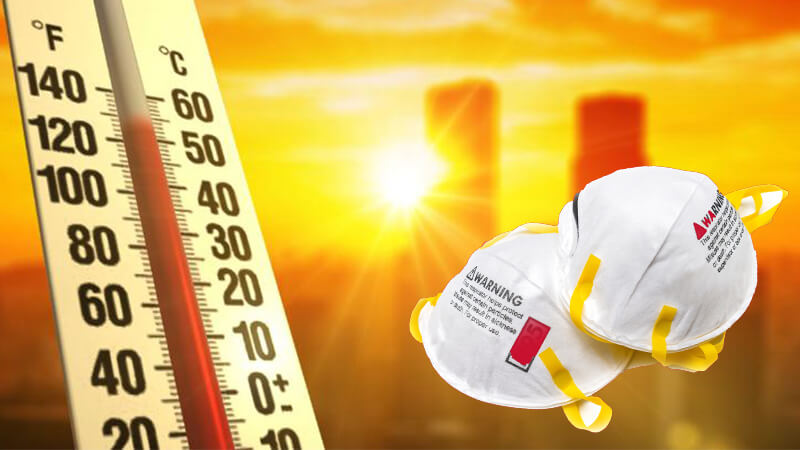
Masks, Coronavirus, and High-Heat Conditions
COVID-19 has greatly impacted construction activity in many ways, from delayed schedules and social distancing to temperature screenings and mandatory masks or face-coverings.
Even though the CDC and WHO both recommend face-coverings as one method of reducing the spread of Coronavirus, masks may introduce additional hazards in the workplace.
Specifically, when working in extreme weather conditions and environments.
In this article, I will outline the heat illness risks and possible construction heat stress prevention strategies as you deploy your team in the summer heat during the Coronavirus pandemic.
Environmental Risks
Hypothetically speaking, which is worse – potentially contracting the coronavirus, or taking the risk of getting heat-stroke? Personally, I would be inclined to face the bug!
In reality, of course, it is not quite so clear. I am not suggesting that wearing a mask alone will cause heat illness. However, I am pointing out that wearing a mask during high-heat working environments, has the potential to elevate the risk of heat stress, which in turn can have immediate life-threatening results.
It is literally the same hazard as wearing a respirator while jogging in the desert, wearing long sleeve clothes, and tool bags around your waist.
Regardless of ambient temperature and humidity, OSHA requires respiratory protection to protect workers from breathable hazards, unless Engineering Controls or similar are established to either reduce or eliminate those hazards.
However, during more extreme weather conditions, more emphasis is placed on implementing special controls, such as rotating workers, taking frequent breaks in the shade, increasing hydration, removing PPE, etc., including Heat Illness training.
Knowing this, simply wearing a mask or face-cover in the heat can and will increase heat-related stressors on the body.

Health Concerns with Mask Usage
Due to recent governmental health orders requiring face-coverings during all social gatherings (including the work environment), site workers are required to wear masks, even if breathable hazards do not exist, and regardless of environmental conditions.
Therefore, we must all remain fully aware that by enforcing the use of masks during high-heat conditions, we may increase the risk to employee’s health.
- Hinders adequate intake of Oxygen (O) and exhalation of Carbon Dioxide (CO2)
- Increases heart rate and blood pressure
- Elevates core body temperature
- Increases fluid loss by excessive sweating
- Lowers ability to drink water (and electrolytes) to replenish fluid loss
- Irritation of the skin (face and ears)
- Impairs vision due to fogged safety glasses
- Increases exposure to high-velocity particles to the eyes because workers remove protective eyewear for cleaning and defogging
- Increases respiratory hazards to individuals who smoke or have underlying medical conditions, such as diabetes, COPD, asthma, heart conditions, etc.
That is to say, while we are using a mask to protect against coronavirus, we are also introducing another set of complications to team member’s health.
Our safety solutions must consider the relative risk abatement for all of these conditions.
You may also enjoy this article.

Construction Heat Stress Prevention
Alternative Solutions
Due to the increased health risks presented by face-coverings in the heat, we are offering the following alternative solutions and support tips:
- Remove face-coverings when remaining a social-distance of at least six feet from others
- Use clear face shields instead of masks (if allowed)
- Use “cooling” neck gaiters – has thinner material and can cool the neck/head while acting as a face covering, plus more easily removable and less irritating.
- Alternate work schedules during cooler hours (early morning or late evening)
- Provide more shade structures around workers outside
- Provide fans, A/C and swamp coolers (if available and practical)
- Take more frequent breaks in cool shaded areas and remove PPE to cool off
- Pour cool water on face and head during the day
Proactive Safety is Always Good Business
Employers are responsible to perform a site-specific hazard assessment to identify both task-related risks and environmental hazards affecting their employees. This also includes identifying and eliminating additional risks/impacts related to your operations, local COVID-19 health orders, and individual worker medical history, just to name a few.
Considering these factors as a whole, and creating a cohesive risk-reduction plan is not just a kind gesture. It is the employer’s best practice for team member health and ensuring a productive workplace.
More Information about Masks and Face Coverings
As we all continue to develop our programs and practices, keep the government guidance at your fingertips.
Here is OSHA’s current guideline for respiratory protection. Moreover, the FDA has also issued recommendations for face coverings and masks.
 Also, as we prepare this article we are happy to see Cal OSHA weigh-in on this critical issue. Here is their guidance.
Thanks for reading!
If you would like any additional tips or safety support, feel free to reach out to me anytime.
Stay safe and cool out there!
About SilMan
SilMan Industries (previously SilMan Construction) is based in San Leandro, California.
Founded in 2008, the firm operates nationwide in three divisions – Construction, Material Handling and Site Services – and partners with “best in class” companies in the Industrial, Manufacturing, Distribution, and Public Works sectors.
For more information, please visit www.silmanindustries.com/about.