
Material Handling Solutions
Automated Order Fulfillment Solutions: Speed, Accuracy, and Scalability
The Imperative for Next-Generation Order Fulfillment
The following article is primarily based on an order fulfillment system developed by the SilMan System Integration Team for a leading medical equipment supplier.
In a highly competitive marketplace, precision, speed, and accuracy are crucial for winning and sustaining customer satisfaction. Continued growth requires a strategic shift from manual processes to automated order fulfillment systems.
There are dual objectives for system modernization: first, to refine and expedite outbound orders, processing daily orders faster, with greater accuracy, and at a lower processing cost per order. Second, to provide internal service teams and external clients with “real-time” order information and immediate tracking data upon shipment
System Design Consultation and Analysis
The foundation of any successful order fulfillment solution is an extensive study and analysis of the client’s overall business and existing processes. The system integration team consults with key stakeholders—from inventory control to service teams—to establish baseline metrics and identify operational deficiencies.
This undertaking produces a clear understanding of the client’s Enterprise Resource Planning (ERP) system and the necessity of fluid information exchange. The process involves collecting current and prior years’ order data to profile order types, determine required staffing levels, and measure information latency.
The data derived from this exercise enables the design of a solution focusing on:
- Increasing storage and order-picking efficiency (fulfillment systems).
- Accelerating data transfer between fulfillment systems and the client service group to increase customer
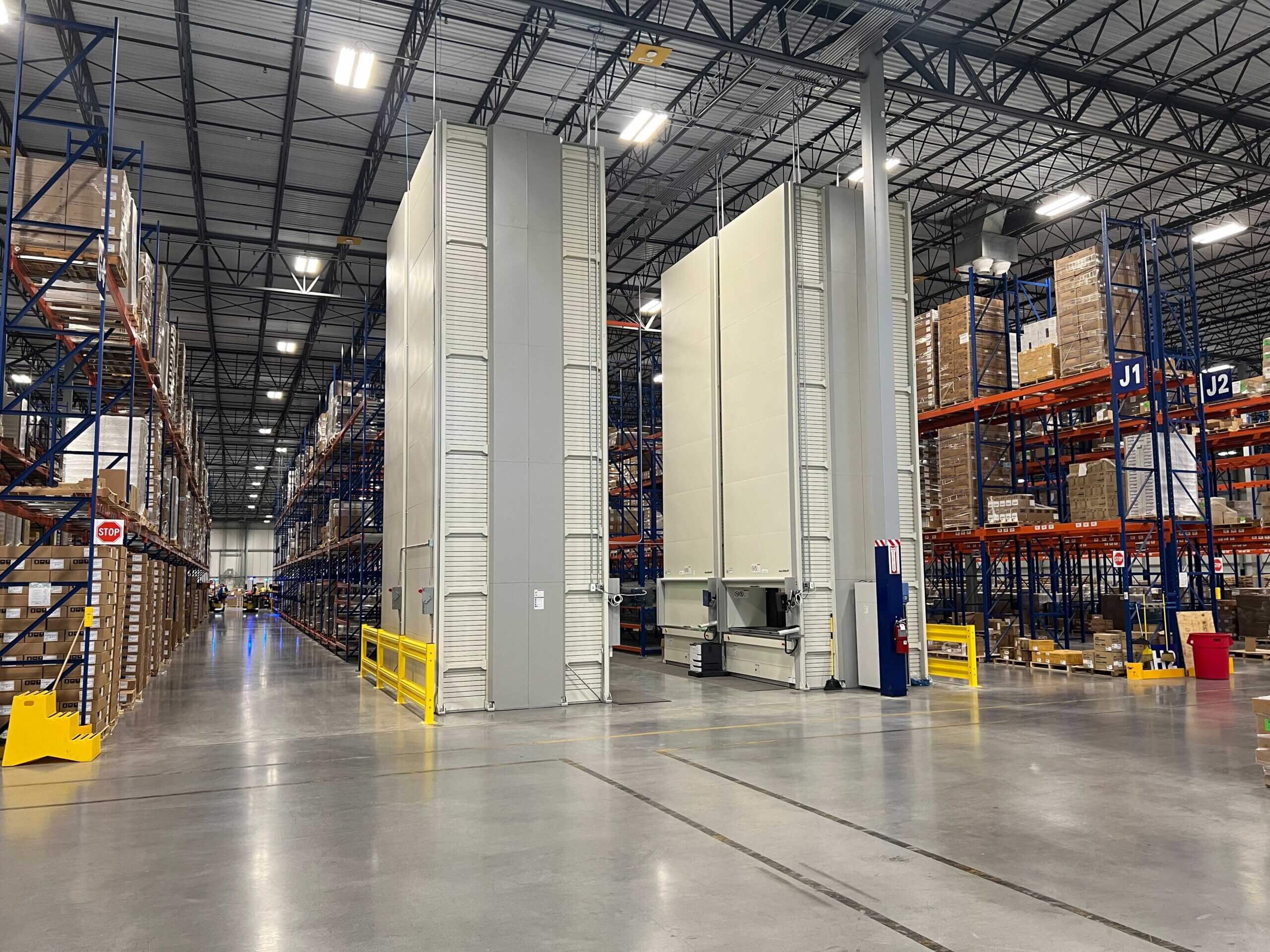
satisfaction. - Introducing automation, including High-Density Vertical Storage, to leverage available building height.
Core System Elements and Advanced Technologies
A comprehensive order fulfillment solution is a tightly integrated assembly of equipment, software, and controls, designed to handle diverse order types—including single-line, multi-line, and large bulk orders.
| Equipment Category | Role in Operational Systems |
|---|---|
| High-Density Goods-to-Person Systems | Automated storage units (such as Hänel Vertical Lift Modules or Shuttle AS/RS) that drastically increase inventory capacity and present items directly to the operator, minimizing travel time. |
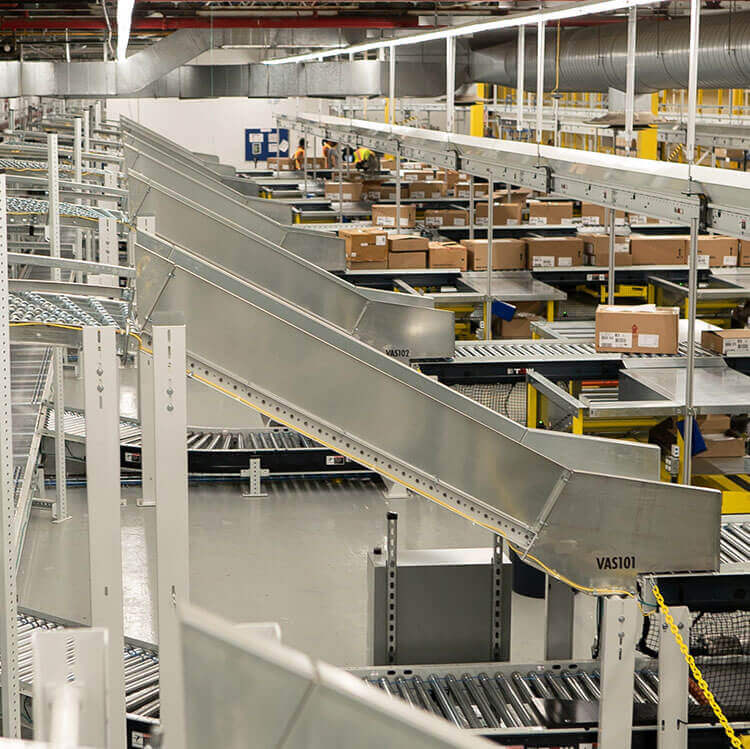
| In-Motion Conveyor Network | The system’s backbone is designed for Zone Routing and expedited material flow through multi-zone picking and sorting processes. |
| Light-Directed Packing Systems | Pick-to-Light and Put-to-Light hardware that provides visual direction to users for accurate item retrieval and placement into specific-order totes. |
| Warehouse Execution System (WES) | The central software layer that manages inventory, orchestrates all material handling equipment, and delivers real-time order and inventory information. |
| Automated Mobile Robotics (AMR) | Modern, flexible robots used for product transport, buffering, and even piece-picking, enhancing efficiency beyond fixed conveyors. |
| Pack Out Workstations | Ergonomically designed areas for manual packing, quality assurance (QA) checks, and applying shipping labels. |
Automated Order Processing: From Induction to Shipping
The advanced fulfillment system orchestrates every package movement and data transaction:
- Item Induction and Decanting: Incoming components are inducted into the WMS/WES and directed for Put-Away. For high-density storage, items may pass through decanting workstations for preparation and placement into standard totes, ready for the storage system.
- Picking and Zone Routing: Orders travel through multi-zone picking areas via the conveyor network. Users employ light-directed systems to retrieve items from high-density storage. Put Walls are often used here to consolidate items picked in batches into discrete, individual customer orders.
- Real-time Transactions: All steps utilize RF mobile devices for paperless, real-time transactions, ensuring absolute inventory accuracy and providing immediate status updates to the service group and the ERP system.
- Pack Out and Labeling: The system logic routes finished order totes to the appropriate packing area, using Automated Packaging Systems for high-speed processing of single-item orders (e.g., mailers) or specialized manual workstations for multi-line orders that require carton assembly, manifest weighing, and label application.
Results: Fulfillment System Performance and ROI
A fully integrated, automated fulfillment system delivers a comprehensive list of improvements that guarantee a strong return on investment (ROI) and provide a platform for future growth.
- Improved Efficiency, Volume, and Accuracy
- Increased Throughput and Storage Capacity
- Reduced Operational Costs
- Enhanced Data Traceability
- Real-time, paperless transactions
Moreover, the physical handling, an integrated automated system, advances the capability and scalability of future expenditures.
Modular system design provides a path to Future-Proof Scalability, enabling seamless integration of next-generation technologies such as Autonomous Mobile Robotics (AMRs) and additional automated storage capacity as order volumes increase.
Simple user interfaces improve the user experience, enabling intuitive training, reducing error rates, and enabling quick adoption by new team members.
Optimized Management Control provides supervisors with meaningful metrics for measuring operator performance, real-time dashboards with relevant KPIs, and intuitive management utilities for better inventory and order tracking.
By leveraging a single-source solution for system design and integration, a facility transforms into an intelligent distribution engine capable of meeting the rigorous speed and accuracy demands of the modern fulfillment landscape.
About the Company
SilMan Industries (previously SilMan Construction) is based in San Leandro, Calif., with Engineering and Field Operations offices in Tupelo, Miss. The firm provides integrated turnkey solutions in the Industrial, Manufacturing, Distribution, and Public Works sectors.
Notably, in 2010 SilMan Industries was contracted to dismantle and remove the NUMMI assembly line in Fremont, Calif., transport the equipment, and reinstall the system in Blue Spring, Miss., establishing Toyota Motor Manufacturing Mississippi (TMMMS). This high-visibility project ignited the company’s meteoric growth, laying the foundation for SilMan’s national service area.
For more information, please visit www.silmanindustries.com/about.

Frequently Asked Questions for Automated Order Fulfillment
What is automated order fulfillment?
Automated order fulfillment uses advanced technologies like conveyors, robotics, automated storage systems, and warehouse software to receive, pick, pack, and ship customer orders with minimal manual intervention. It delivers faster processing, higher accuracy, real-time tracking, and future-proof scalability for distribution and e-commerce operations.
What are the main benefits of an automated order fulfillment system?
An automated order fulfillment system significantly improves picking accuracy, processing speed, and storage density. Benefits can be amplified by integrating technologies such as Goods-to-Person (GTP) and Warehouse Execution Systems (WES). Automated fulfillment systems can reduce labor costs, minimize human errors, and provide real-time tracking data to customers, leading to a faster return on investment (ROI).
How do Goods-to-Person (GTP) systems improve warehouse efficiency?
Goods-to-Person (GTP) systems, such as Hänel Vertical Lift Modules (VLMs) or Shuttle AS/RS, improve efficiency by delivering items directly to the operator. This eliminates the "walk time" associated with traditional manual picking, drastically reducing worker fatigue, increasing throughput, and allowing for higher inventory density by utilizing the full vertical height of a warehouse or distribution facility.
What is the difference between Pick-to-Light and Put-to-Light systems?
Pick-to-Light uses light displays to direct operators to the correct storage location and quantity of items to be retrieved for an order. Put-to-Light (often used with "Put Walls") directs the operator to the correct bin or order tote where a picked item should be placed to consolidate multi-line orders. Both systems improve speed and virtually eliminate picking errors.
