
Material Handling Solutions
Material Handling and Logistics in the Bottling & Beverage Sector
The bottling and beverage industry operates under unique demands: extremely high volumes, rapid throughput, and stringent hygiene standards. Success in this sector hinges entirely on the seamless integration of material handling systems that move containers—cans, bottles, or cartons—at high speeds with minimal disruption, from raw ingredient intake to final shipment.
The beverage supply chain is highly mechanized, relying on precise, automated systems to maintain product quality, ensure food safety compliance, and maximize profitability through operational efficiency. These systems are responsible for controlling every movement within the production environment, ensuring that a single defective container does not compromise line speed or product quality.
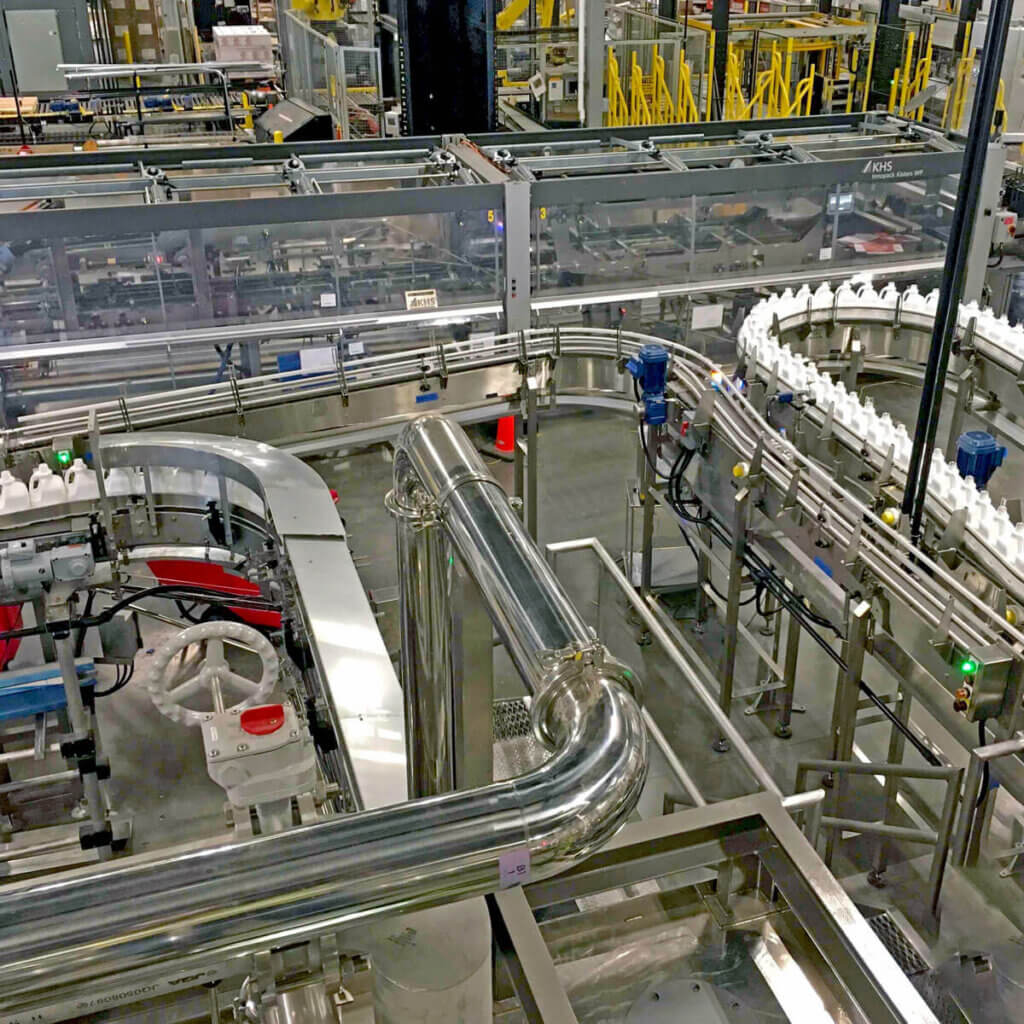
The Production Line Flow
The beverage production line is a complex, continuous-flow system that starts with empty container handling and ends with a palletized product ready for distribution.
1. Empty Container Handling & Cleaning
The process begins by transferring empty containers—cans or glass/PET bottles—from bulk storage (depalletization) to the production line. Containers are meticulously cleaned, typically via rinsing or air blasting, to remove any debris. This is a critical point where container integrity is often checked via inspection systems.
2. Filling and Sealing
Containers move into the filler/seamer where the beverage is introduced, and the container is immediately sealed (capped or seamed). This high-precision operation demands extremely tight tolerances and is often executed by a monoblock machine that combines rinsing, filling, and sealing functions to maintain speed and a sterile environment.
3. Inspection and Packaging
Post-filling, every container undergoes rigorous inspection (weight, fill level, cap integrity, label placement) before entering primary and secondary packaging. Primary packaging involves cartoning or wrapping individual units. Secondary packaging groups these units into cases or trays, preparing them for final palletization.
4. End-of-Line Automation
The completed cases are conveyed to the end-of-line systems for final preparation, including palletizing and stretch wrapping, before being staged for loading and outbound shipment.

| Equipment/System | Primary Function | Context/Relevance |
|---|---|---|
| Depalletizer | Automatically unloads empty containers m(cans, bottles) layer by layer from bulk pallets and feeds them onto the production line conveyors. | Initiates the production process; requires high-speed synchronized movement. |
| Monoblock Systems | Combines rinsing/cleaning, filling, and sealing (capping/seaming) into one highly synchronized machine. | Maximizes throughput and minimizes exposure time to maintain product hygiene and sterility. |
| Inspection Systems | Uses vision, X-ray, or laser technology to verify fill levels, cap presence, label accuracy, and foreign material. | Critical quality control points to ensure compliance and prevent product recalls. |
| Case Packers/Cartoners | Places single containers into final consumer packaging units (e.g., 6-packs) and then into secondary packaging (cases, trays). | Prepares product for retail display and provides necessary protection for handling |
| Conveyor Networks | The primary transport system uses stainless steel belts and chains to move containers/cases between all machines. | Requires sanitary design, precise alignment, and accumulation zones to buffer machine speed changes. |
| Palletizer | Automatically stacks filled cases into layers on a pallet according to a specific pattern (recipe). | Final stage of production, creating a stable, standardized unit load for warehousing and shipping. |
| Stretch Wrapper | Final stage of production, creating a stable, standardized unit load for warehousing and shipping. | Secures the load for stability during transport, protecting against shifting and contamination. |
| Loading Docks/WMS Integration | Interface between the production facility and transport carriers (trucks, rail). | Manages inventory location, assigns loads, and tracks final outbound shipment details. |
End-of-Line and Outbound Shipping Systems
The effectiveness of a bottling operation is ultimately measured by its ability to efficiently ship finished goods. The integration of end-of-line material handling with outbound logistics is paramount.
Unit Load Creation:
Palletizing systems, whether robotic or conventional layer-by-layer machines, transform individual cases into a stable, shippable unit load. The choice of palletizer (e.g., high-level, low-level, or robotic) depends on speed requirements and case stability. Once stacked, the pallet is automatically stretch-wrapped to provide load containment and weather protection, with some systems incorporating barcode readers for verification.
Warehouse Integration and Shipping:
From the wrapper, the finished pallet is moved into the warehouse or distribution center. This is managed by the Warehouse Management System (WMS), which dictates where the pallet is stored (often using Automated Storage and Retrieval Systems, or ASRS, for high-density storage) and when it is retrieved for shipment. Outbound shipping processes include:
- Order Fulfillment: Pallets are staged according to pending truck or rail load schedules.
- Conveyance to Dock: Automated guided vehicles (AGVs) or pallet conveyors move loads from storage to the dock doors.
- Load Verification: Final scans at the dock confirm the correct product and quantity are loaded onto the correct carrier, ensuring manifest accuracy.
Facility Infrastructure and Compliance
Material handling systems require robust facility infrastructure, particularly in environments governed by strict sanitary guidelines. The facility must accommodate heavy machinery and constant washdown cycles. This includes:
- Industrial Flooring: Floors must be chemically resistant, non-porous (often with high-strength epoxy coatings), and capable of withstanding thermal shock from hot-water cleaning.
- Sanitary Drainage: Trench drains and floor systems must be strategically engineered to quickly and efficiently remove waste and cleaning fluids, preventing standing water and bacterial growth.
- Structural Support: Custom platforms, mezzanines, and equipment pads are frequently installed to support heavy machinery and provide safe access for maintenance personnel, often requiring complex integration with mechanical systems and structures.
Benefits of Optimized Bottling Systems
The integration and synchronization of these specialized systems yield crucial benefits for beverage producers. First, Maximized Throughput is achieved by eliminating bottlenecks and maintaining continuous, high-speed flow through precise singulation and gapping. Second, Enhanced Financial Accuracy and Compliance is secured through the use of accurate inspection and dimensioning systems, guaranteeing every shipped product meets quality standards and every load is correctly verified.
Finally, the strategic adoption of automation—from depalletizing to palletizing—results in a significant increase in Labor Efficiency, allowing personnel to focus on high-value tasks like maintenance, sanitation, and exception handling rather than on manual, repetitive processes. Ultimately, an optimized bottling system reduces operational costs, minimizes product loss, and ensures rapid, reliable delivery to the market.
Take a deeper dive into SilMan capabilities: Our Specialty Trade Services and project management team are fully integrated with our design and engineering group, providing outstanding results in food and beverage manufacturing, warehouse solutions, and end-to-end innovative manufacturing solutions.
About the Company
SilMan Industries (previously SilMan Construction) is based in San Leandro, Calif., with Engineering and Field Operations offices in Tupelo, Miss. The firm provides integrated turnkey solutions in the Industrial, Manufacturing, Distribution, and Public Works sectors.
Notably, in 2010 SilMan Industries was contracted to dismantle and remove the NUMMI assembly line in Fremont, Calif., transport the equipment, and reinstall the system in Blue Spring, Miss., establishing Toyota Motor Manufacturing Mississippi (TMMMS). This high-visibility project ignited the company’s meteoric growth, laying the foundation for SilMan’s national service area.
For more information, please visit www.silmanindustries.com/about.

Frequently Asked Questions for Beverage Bottling
What are the key components of an automated bottling production line?
An automated bottling production line consists of several integrated stages: depalletization for removing empty containers from bulk storage, monoblock systems for rinsing and filling the containers, inspection systems using vision, X-ray, or laser technology for quality control, case packers for final consumer packaging and secondary packaging such as cases or trays, and automated palletizers with stretch wrappers for final warehousing and shipping preparation.
How can beverage manufacturers improve production line throughput?
Manufacturers can maximize throughput by integrating precise high-speed singulation and gapping to eliminate bottlenecks. Utilizing monoblock filling and sealing units to combine rinsing/cleaning, filling, and sealing (capping/seaming) into one highly synchronized machine, which helps maintain sterility and minimizes transit time. Automated end-of-line systems utilizing robotic palletizers and automated guided vehicles, integrated with a Warehouse Management System ensure the finished product moves to the warehouse or shipping area without slowing down the primary line.
What facility requirements are necessary for a sanitary bottling environment?
Sanitary bottling facilities require specialized infrastructure to meet hygiene standards, including non-porous chemically resistant industrial flooring that's capable of withstanding thermal shock from hot water cleaning. Integrated sanitary drainage systems are necessary to quickly eliminate water and cleaning fluids, thereby preventing bacterial growth. Stainless steel conveyor networks must be designed for frequent washdown cycles. Finally, structural support for equipment pads for heavy machinery, mezzanines, and custom platforms for safe access for maintenance and cleaning are often required.
