
Material Handling Solutions
Singulation: The Foundation of High-Speed Sortation
Singulation is the fundamental process within any automated material handling system that demands high throughput and precision, making it the non-negotiable first step in all high-speed sortation processes.
When cartons, totes, or parcels exit a merge point—where several conveyor lines converge—they often arrive in a continuous, disorganized stream known as a “mass flow” or “slug.” Singulation transforms this mass flow into a predictable, single-file stream of items separated by uniform, predetermined gaps.
Without this separation, downstream automation equipment—such as barcode scanners, dynamic weighing systems (DWS), and the sorters themselves—cannot accurately process or track individual packages. The efficacy of the entire sorting system, and thus the distribution center’s throughput, depends directly on the quality and consistency of the upstream singulation process.
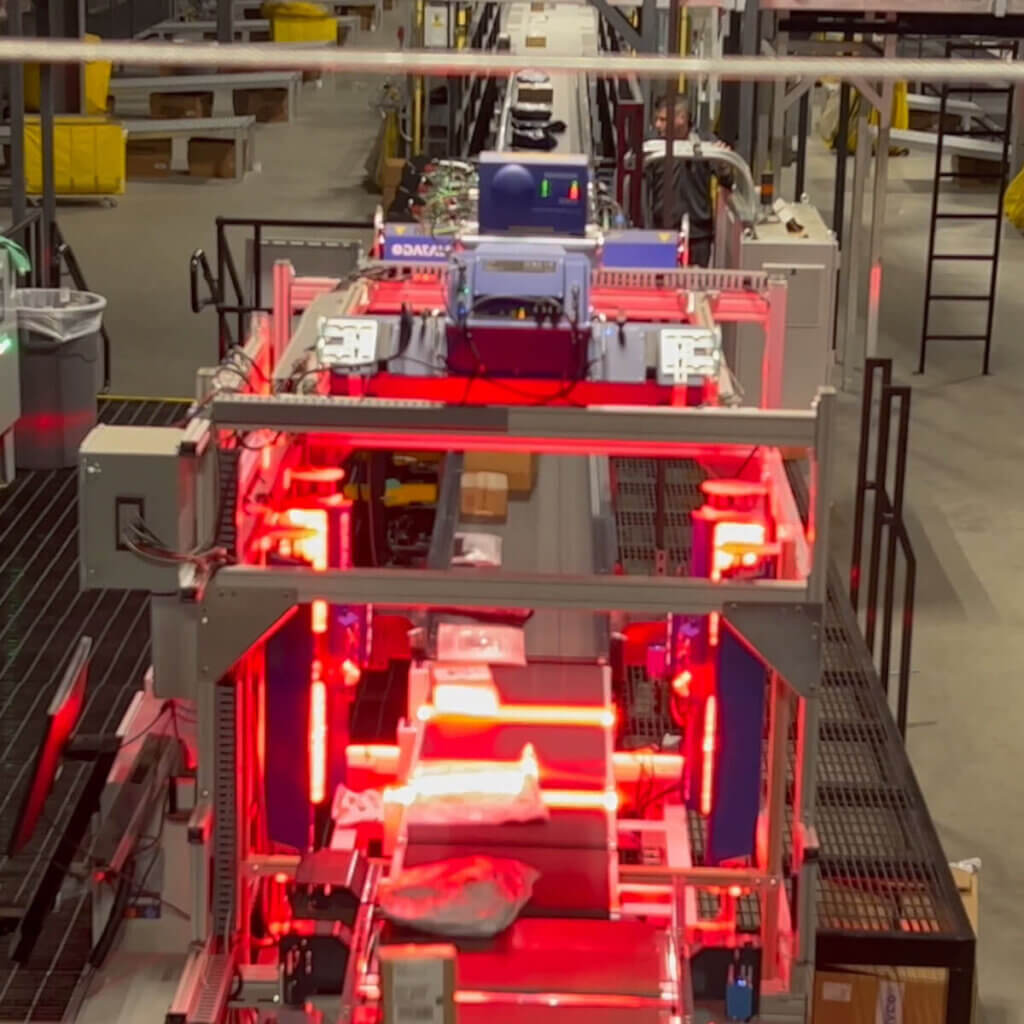
The Technical Process of Singulation and Gapping
Singulation is executed by a specialized section of conveyor that utilizes speed differentiation to create the necessary space between products. This section is often referred to as a Gapping Belt Induction Conveyor or simply a “gapper.”
The system operates based on item dimensions, tracking, and controlled acceleration:
Induction and Accumulation: Items enter the singulation zone from accumulation lanes or merge conveyors, where they may be touching.
Detection: Photo-eye sensors or volumetric scanners detect the leading and trailing edges of each package as it enters the zone.
Speed Differential: The gapping conveyor is segmented into two or more independent belts. The first segment runs slower than the second. When a gap is required, the first package accelerates onto the faster belt while the following package remains momentarily on the slower belt. This speed change pulls a gap between the two items.
Control and Synchronization: Sophisticated controls and logic constantly monitor product length and position. Systems often utilize Gap Optimization—a process where belt speeds are dynamically adjusted based on sensor feedback to maintain a consistent gap size, regardless of varying package dimensions. This maximizes system throughput by ensuring no wasted space exists between the minimum required gap and the item behind it.
Alignment: In addition to separation, some singulators may also use skewed rollers or specialized guiding to align packages to one side of the conveyor, preparing them for highly accurate processing through scan tunnels or automated labeling equipment.

Key Equipment for Singulation and Gapping
Industry leaders like Dematic, Daifuku, Bastian Solutions, and MHS rely on specialized modular conveyor equipment to achieve accurate singulation:
| Equipment/System | Primary Function | Role in the Sortation Process |
|---|---|---|
| Gapping Belt Induction | Utilizes multi-speed conveyor belts to physically separate and create a uniform space (gap) between items | Necessary upstream component to prepare items for scanning and high-speed divert. |
| Skewed Rollers | Rollers set at an angle that gently guide packages to one side of the conveyor. | Ensures product alignment for consistent barcode reading and label application. |
| Vision System/Sensors | High-resolution cameras and photo-eyes are used to determine the exact length and position of each item. | Provides data necessary for the control system to calculate the required acceleration and deceleration rates for gap optimization. |
| Merge Conveyors | Designed to consolidate multiple inbound lines into one single flow before the singulation process begins. | Creates the initial “mass flow” of products that the singulator is designed to manage and organize. |
| Warehouse Control System (WCS) | The software layer that manages item tracking, speed commands, and gap protocols across the equipment. | Maintains the one-to-one relationship between the physical package and its digital data (ID, destination). |
Benefits of Precise Singulation
The proper implementation of singulation systems provides distinct operational benefits essential for modern logistics centers:
- Maximized Throughput: By optimizing the gap between products, the system processes the maximum number of items per hour, ensuring sorters run at their rated capacity (e.g., up to 24,000 items per hour on high-speed sliding shoe sorters).
- Accuracy and Reliability: Consistent spacing drastically improves the “read rate” success of scan tunnels. When items are too close together, scanners often miss one or both packages, leading to manual exception handling and significant delays.
- Preventing Jams and Damage: A controlled, single-file stream prevents packages from colliding or jumbling as they enter the high-speed divert mechanism of the main sorter.
- Automation Enablement: Precise gapping provides the necessary window for ancillary equipment (such as Print & Apply Labelers or Dimensioning Systems) to execute their tasks on one package before the next item arrives.
Singulation is the crucial control mechanism that converts chaotic input into predictable, high-performance output, serving as the gateway to all downstream automated processes.
About the Company
SilMan Industries (previously SilMan Construction) is based in San Leandro, Calif., with Engineering and Field Operations offices in Tupelo, Miss. The firm provides integrated turnkey solutions in the Industrial, Manufacturing, Distribution, and Public Works sectors.
Notably, in 2010 SilMan Industries was contracted to dismantle and remove the NUMMI assembly line in Fremont, Calif., transport the equipment, and reinstall the system in Blue Spring, Miss., establishing Toyota Motor Manufacturing Mississippi (TMMMS). This high-visibility project ignited the company’s meteoric growth, laying the foundation for SilMan’s national service area.
For more information, please visit www.silmanindustries.com/about.

Frequently Asked Questions for Singulation
What is singulation in material handling?
Singulation is a critical first step in automated material handling systems. It's the process of transforming a disorganized "mass flow" or "slug" of items into a single-file stream with uniform, predetermined gaps. Singulation allows downstream equipment such as barcode scanners, dynamic weighing systems, and sorters to identify and process individual packages accurately without interference from trailing items.
How does a gapping conveyor create space between packages?
A gapping conveyor uses speed differentiation across multiple independent belt segments. As a package moves from a slower induction belt to a faster downstream belt, the increase in velocity pulls the item away from the one behind it. High-resolution cameras and photo-eye sensors provide continuous data to the Warehouse Control System (WCS). This software dynamically adjusts belt speeds to maintain consistent, optimized gaps regardless of package size.
Why is precise gapping necessary for high-speed sortation?
Precise gapping ensures that automated scan tunnels can achieve a 100% read rate and that high-speed divert mechanisms have enough time to reset between items. It enables integration with automated labelers and weighers. Precise gapping reduces manual labor, cuts costs, and increases reliability in logistics and warehousing operations. Without consistent gaps, packages may be misread, collide during sorting, or cause system jams, leading to manual exceptions and reduced facility throughput.
