
Robotic Tote Sortation
System Integration and Implementation
PROJECT SCOPE
System Design & Integration, Consultation & Analysis, Project Management, Electrical & Mechanical Engineering, Warehouse Execution system, Warehouse Controls System, Mechanical & Electrical Installation
INDUSTRY
Distribution & Fulfillment
Transforming Fulfillment Operations: SilMan Industries Delivers Multi-Site Robotic Work Cell Integration for Leading Provider
Operational efficiency defines the competitiveness of fulfillment market leaders. When a leading operator sought to implement advanced Robotic Tote Palletizing Systems across nine distribution centers, they turned to SilMan Industries for a comprehensive approach that would deliver value far beyond equipment installation itself. This case study examines how SilMan’s conveyor systems and integrated approach to engineering, design implementation, and controls delivered a seamless process across multiple facilities, setting new standards for deploying automated fulfillment solutions.
Key Success Factors: The SilMan Advantage
Several factors distinguished SilMan’s approach and ensured project success:
Self-Performance Model
By self-performing critical work and utilizing key partners, SilMan maintained direct control over quality, schedule, and safety. This approach eliminated finger-pointing and ensured accountability at every level.
Specialized Expertise
SilMan’s teams brought deep expertise in their respective disciplines:
- Engineering: Three decades of conveyor system design experience
- Controls: Extensive background in parcel handling and distribution systems
- Safety: Avetta-certified programs ensuring OSHA compliance
- Mechanical/Electrical: Proven track record with major logistics providers
Technology Selection
The choice of proven Wynright MDR conveyor technology, already operational in the client’s network, minimized risk and accelerated deployment. This strategic decision balanced innovation with reliability.
Speak to a key team member on this project

Meet David Rebata
For more information about this project or related topics, contact David by email or call directly at 510.409.6567.
You may also enjoy this article
The Challenge: Scaling Robotic Palletizing Systems Across Multiple Sites
The modern fulfillment industry faces relentless pressure to accelerate throughput while maintaining accuracy and reducing operational costs. For this leading provider, the solution lay in deploying sophisticated robotic palletizing systems—but success required more than just placing robots on the warehouse floor.
The challenge was multifaceted:
- Scale: Multiple distinct distribution centers required consistent implementation
- Complexity: Integration with existing operations while minimizing interruptions to current operations.
- Performance: Exceeding current manual tote palletizing rates with the new Robotic Palletizing Systems.
- Compliance: Navigating diverse local regulations and permitting requirements across multiple states and jurisdictions.
The project required a partner capable of delivering turnkey material handling solutions that encompassed engineering design, electrical controls, infrastructure preparation, and seamless integration with robotic systems—all while maintaining operational continuity.
SilMan’s Solution: Comprehensive Self-Performance Model
SilMan Industries approached this challenge with a proven self-performance model that consolidated multiple specialties under single-source accountability. Rather than managing multiple contractors, the client gained a unified partner capable of executing every aspect of the project from initial engineering through final commissioning.
Engineering Excellence: Foundation for Success
SilMan’s engineering team began with comprehensive site assessments and system design, developing customized tote sortation solutions for each location while maintaining standardization where possible. The engineering scope encompassed:
Systems Design and Integration
- Development of electrical material handling designs
- Integration planning to ensure seamless communication between conveyor systems and robotic cells
- Power studies and risk assessments to identify and mitigate potential operational challenges and infrastructure
Regulatory Compliance and Permitting
- Preparation of complete permit packages, including structural calculations and electrical submittals
- Management of all city and special inspections throughout the implementation at multiple locations and states
- Delivery of final permit sign-off documentation for each location
This proactive engineering approach eliminated delays and ensured each system met both operational requirements and local regulations.
Mechanical and Electrical Implementation: Precision in Practice
The heart of the project involved installing sophisticated conveyor systems that would feed totes to the robotic palletizers. SilMan’s mechanical and electrical teams executed this critical work with precision across multiple states.
Infrastructure Development
- Installation of robotic cell footings per structural engineered specification
- Implementation of robust power infrastructure, including 480V (30 Amps) and 120V (15 Amps) systems
- Installation of data lines for full integration with the client’s Warehouse Control System.
- Air drop systems for pneumatic control devices
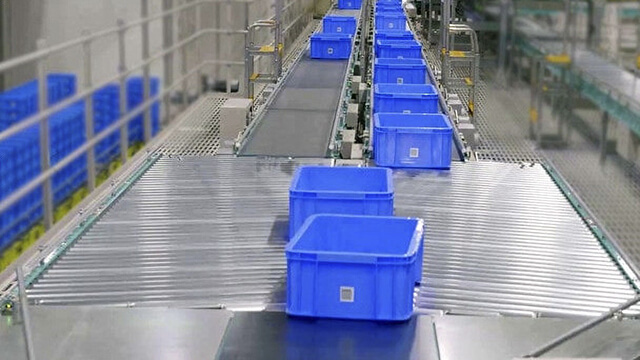
Conveyor System Deployment SilMan provided Wynright MDR (Motor Driven Roller) Autoroll conveyors, specifically configured for tote handling, reduced power consumption, and noise cancellation.
- Right-angle transfer devices for tote management and orientation, where required
- 90-degree curves and transfers for precise tote orientation
- Power Pivot Diverter Sorters for automated tote sorting
- Zero Pressure Accumulation conveyors for metering tote flow and accumulation
Each conveyor system was engineered to ensure totes approached the robotic cells with narrow-side leading orientation, critical for proper robotic tote palletizing. The proven Wynright technology, already operational in several of the client’s facilities, ensured reliability and familiarity for maintenance teams.
Controls Integration: The Digital Nervous System
SilMan’s controls team created the sophisticated digital infrastructure that orchestrates the entire operation. This encompassed:
Control System Architecture
- Client-specified MCC panels integrated with SilMan-designed control logic
- ERSC control cards for intelligent tote management
- Comprehensive safety systems including e-stops, photo-eyes, and warning beacons
- Cognex scan tunnels for automated tote data and tote contents dimensioning
The controls team implemented precise handshake protocols between SilMan conveyors and the Robotic Palletizer, ensuring smooth tote release, preventing jams, and improving tote throughput in warehouses. This seamless integration was crucial for achieving the required throughput rates and exceeding system rates.
Project Management: Orchestrating Success
SilMan’s project management team served as the central nervous system for this complex, multi-site deployment. Using Procore, their proprietary project management platform, they provided:
Real-Time Visibility
- 24/7 access to project data for all stakeholders
- Comprehensive documentation management
- Issue tracking and resolution workflows
- Schedule coordination across multiple simultaneous implementations
On-Site Leadership Full-time site managers at each location ensured consistent execution, rapid problem resolution, and seamless coordination between project teams. This dedicated presence proved invaluable for maintaining project momentum and quality standards.

Results: Operational Excellence Achieved
The successful implementation of the robotic palletizing systems across multiple distribution centers delivered measurable operational improvements:
Performance Metrics
- Achieved target throughput and exceeded target rates
- Seamless integration with existing warehouse management systems
- Zero safety incidents throughout implementation
- All sites operational on schedule
Operational Benefits
- Increased fulfillment capacity without facility expansion
- Reduced labor for tote palletizing
- Improved ergonomics by eliminating manual tote handling
- Enhanced order accuracy through automated processes
Long-Term Value
- Comprehensive as-built documentation for simplified maintenance, and long-term SilMan Industries life cycle support
- Standardized systems across locations for operational consistency
- Proven technology with established maintenance protocols
- Scalable infrastructure ready for future expansion
- Highly cost-effective tote sortation solutions
Lessons Learned: Blueprint for Future Success
This project reinforced several critical insights for large-scale automation deployments:
Early Engineering Investment Pays Dividends
- Comprehensive upfront engineering, including detailed site assessments and risk analyses, prevented costly mid-project modifications.
Standardization with Flexibility
- While maintaining equipment standards across sites, SilMan’s ability to integrate existing systems with new technology and customize layouts for each location’s unique requirements proved essential.
Communication is Critical
- The Procore platform’s real-time visibility enabled rapid decision-making and kept all stakeholders aligned throughout the project.
Safety Cannot Be Compromised
- Maintaining zero incidents across multiple simultaneous implementations validated SilMan’s investment in comprehensive safety programs.
Setting New Standards in Automated Tote Sorting in Fulfillment
The successful deployment of Robotic Tote Palletizing Systems across multiple distribution centers represents more than a technical achievement—it demonstrates the transformative power of integrated project delivery in modern logistics. By combining engineering excellence, proven technology, and flawless execution, SilMan Industries enabled their client to achieve new levels of operational efficiency.
As the fulfillment industry continues its rapid evolution toward greater automation, this project serves as a blueprint for successful implementation. The key lies not in any single technology or process, but in the orchestrated application of multiple specialties working in concert toward a common goal.
For logistics providers seeking to enhance their competitive position through automation, SilMan Industries has proven that success requires more than equipment—it demands a partner capable of delivering comprehensive solutions that transform operational capabilities. Through their self-performance model and integrated approach, SilMan continues to set the standard for industrial automation implementation and integration one successful project at a time.
About the Company
SilMan Industries (previously SilMan Construction) is based in San Leandro, Calif., with Engineering and Field Operations offices in Tupelo, Miss. The firm provides integrated turnkey solutions in the Industrial, Manufacturing, Distribution, and Public Works sectors.
Notably, in 2010 SilMan Industries was contracted to dismantle and remove the NUMMI assembly line in Fremont, Calif., transport the equipment, and reinstall the system in Blue Spring, Miss., establishing Toyota Motor Manufacturing Mississippi (TMMMS). This high-visibility project ignited the company’s meteoric growth, laying the foundation for SilMan’s national service area.
For more information, please visit www.silmanindustries.com/about.
Integrated Material Handling Solutions
The SilMan System Integration team provides conveyor equipment and automation solutions to industry-leading companies in multiple sectors across the US. The company has built this reputation on the unique insight and value delivered on every project. These outcomes begin by seeking a deep understanding of overarching business objectives to identify the highest-value course of action. SilMan’s Specialty Trade Services and project management team are fully integrated with our design and engineering group, providing outstanding results in food and beverage manufacturing, warehouse solutions, and end-to-end innovative manufacturing solutions.
Frequently Asked Questions for Robotic Tote Sortation
What is the primary benefit of a robotic tote sortation system?
The primary benefit of robotic tote sortation is greatly enhanced operational efficiency. This is accomplished by significantly accelerating tote throughput and reducing manual labor for tote palletizing. It also improves ergonomics and order accuracy in fulfillment operations.
What role does MDR (Motor Driven Roller) conveyor technology play in robotic sortation?
MDR (Motor Driven Roller) conveyors provide quiet, energy-efficient transport and are essential for Zero Pressure Accumulation. Totes can then be precisely metered to the robotic work cells, which is critical for smooth integration and preventing jams.
What is the key to successfully deploying robotic systems across multiple facilities?
The key is using a self-performance model with standardized system designs and centralized project management. The benefits of utilizing this model include: consistent quality, regulatory compliance across diverse jurisdictions, and seamless integration with existing Warehouse Management Systems.
