Do Masks Really Make a Difference?
A Closer Look at Face Coverings from an Occupational Safety Perspective

Synopsis: Masks are not a perfect solution to protect ourselves and others against the Coronavirus. Nor are they the only option. In the industrial sector, face coverings are considered the last line of defense within a hierarchy of controls to reduce or eliminate risk. However, masks remain one of the most important tools at our disposal, especially if other solutions are lacking or fail.
“We have a vaccine, why do I still need to wear a mask?”
The introduction of approved vaccines has offered a pandemic-weary world a light at the end of the proverbial tunnel. However, our journey is not over; we still have a long way to go. Or, to extend the D-Day Invasion analogy by U.S. Army General Gustave Perna, it’s the “beginning of the end”.
In light of this critical turn of events, I thought it might be helpful to answer this question by taking a closer look at the role of face coverings from the perspective of the industrial community. My objective is to help us all understand their effectiveness as a risk mitigation tool within the broader context of a health and safety program.
The CDC calls this system of risk management the “Hierarchy of Controls.”
Personal Protective Equipment (PPE): Our Last Line of Defense
Using the graphic above, we immediately notice that “PPE” appears at the bottom of the pyramid and is labeled as “Least-Effective” to protect us from a hazard.
This position, however, is not intended to indicate a lack of importance. Instead, this image helps us to appreciate the relative importance of other aspects of controlling risks, and where PPE provides its primary value.
On July 14, 2020, the CDC formally published a press release titled “Calling Americans to wear masks to prevent COVID-19 spread”. The article affirms that “cloth face coverings are a critical tool in the fight against COVID-19, that could reduce the spread of the disease, particularly when used universally within communities.”
During a pandemic, masks are a “personal” safety action that is necessary when entering public areas when the risk of exposure is present.
Note that while masks fall into the category of “protective equipment,” it is important to understand that their primary purpose is to protect others, even though we apply them to ourselves. For example, think of doctors wearing masks in surgery: the patient is the one being protected by the mask, not the doctor.
Masks: One Piece of a Bigger Picture
It should be stressed that masks are not a standalone solution to stop the spread of disease. As the CDC points out in the above quote, the power of face coverings is their “universal” application.
And as we shall see in the examples below, the Hierarchy of Controls in both industrial and community settings shows us that the effectiveness of masks is compromised without a systemwide approach to addressing health and safety risks.
That is, face coverings cannot replace higher-level controls such as isolation and physical distancing.
The Hierarchy of Controls in Practice
To get a clearer view of the big picture, let’s compare how the Hierarchy of Controls are applied in Occupation Safety and Public Health.
Here are a few real-world examples in each sphere, along with a brief description of each level of risk control.
1. Elimination
Eliminating a hazard is the most effective mitigation tool and our best line of defense, yet is commonly not feasible. Regardless, eliminating the hazard should always be considered a viable first option.
Occupational Safety: Avoiding high-risk tasks, or outsourcing to a third party. For example, to eliminate the threat of electrocution, hire a local utility company to shut off the main power to the building.
Public Health: Shelter-in-place at home, instead of working at an office or on-site. We can also outsource or reject high-risk work to avoid exposure. Unfortunately, eliminating the virus entirely is nearly impossible if we wish to produce and distribute essential goods and services.
2. Substitution
Sometimes, it is more practical to substitute certain activities, processes, or equipment with others, rather than eliminating the risk.
Occupational Safety: Replacing a ladder with a scissor lift to perform work at heights. Using a remote control robot to demo concrete in lieu of using workers, or reschedule work to avoid exposing personnel to specific construction hazards.
Public Health: Instead of working in the office, we can work from home. We can substitute meeting in a conference room with internet video conferencing.
3. Engineering
Engineering and design can be utilized to isolate or reduce hazards in processes, equipment, systems, or workstations.
Occupational Safety: A workstation forcing repetitive bending over throughout the day is redesigned/rebuilt with a moveable or higher surface to prevent back strains. Substitute an unsafe machine with a safer one.
Public Health: Staging socially-distanced seating, installing plastic dividers between workstations, or increasing filtration and ventilation systems.
4. Administrative
Administrative controls are designed to eliminate or reduce hazards by changing how we work. That is, by creating and implementing policies, procedures, and processes.
Occupational Safety: Following lock-out/tag-out procedures for high-voltage equipment, since most energy sources cannot commonly be eliminated, substituted, nor re-engineered.
Public Health: Reduction of occupancy for indoor activities, directional pathways through common corridors, six-foot spaced floor markings where lines are formed.
Testing and Tracing are also administrative remedies that can lead to the quarantine of positive cases, and a better understanding of infection source(s) to prevent outbreaks. These efforts could remove the contractible hazard from public spaces.
5. PPE – Masks
As mentioned earlier, PPE is our last line of defense and is typically the least effective method to control a hazard. PPE is only as protective as the product’s design limitations and the user’s diligence.
If mask design is not adequate or worn properly, they could render themselves useless. PPE must be properly sourced, worn, maintained, and stored, in order to be effective.
However, as we have seen above, a mask may not be relied upon as sole protection from the hazard.
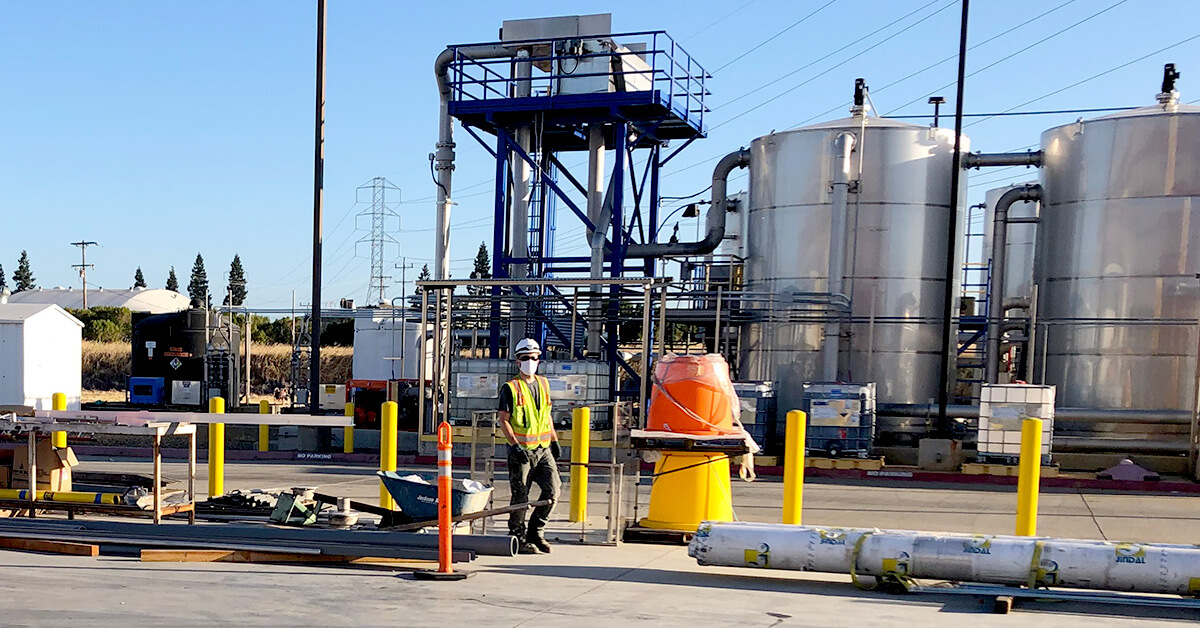
Occupational Safety: Safety glasses, hard-hats, N95 masks, gloves, and safety vests.
Public Health: Wear face masks whenever near others, and when social distancing cannot be achieved, especially indoors. Properly wear a 2+ layer face cover (mask) over your mouth and nose with minimal gaps.
Did you know:
The Hierarchy of Controls was originally created by the National Safety Council in 1950. Learn more about the origins of this approach, as well as the governmental agencies involved.
Realistic Expectations for Masks in 2021
Today, with the arrival of vaccines, comes the potential for vigilance to wane. We have not reached the end of the proverbial tunnel just yet.
Additionally, we must face further uncertainties such as additional strains of COVID-19, slow roll-out inoculation efforts in smaller communities, and progress toward to herd immunity.
The bottom line is that masks are likely to be with us for months, if not years, to come.
Many of us have experienced a patchwork of preventative control methods in our communities, as well as resistance to embracing higher-level controls.
The result is that we are increasingly forced to rely on our masks as a primary remedy, despite their shortcomings.
With these realities, we are all called upon to renew our commitment to personal safety and the well-being of others.
Hopefully, this macro-view of masks within a larger public health hierarchy of controls can help you utilize this tool with confidence.
Safety at SilMan
You may find more articles like this, as well as information about SilMan’s safety program, at silmanindustries.com/safety.
If you are looking for additional Coronavirus materials, our Safety Team has produced a “COVID-19 Exposure, Control, Prevention, and Response Plan,” which is available to the public and may be downloaded here. (updated, December 2020)
To learn more about SilMan, please visit www.silmanindustries.com/about.