
In-House Skilled Trades
Industrial Rigging
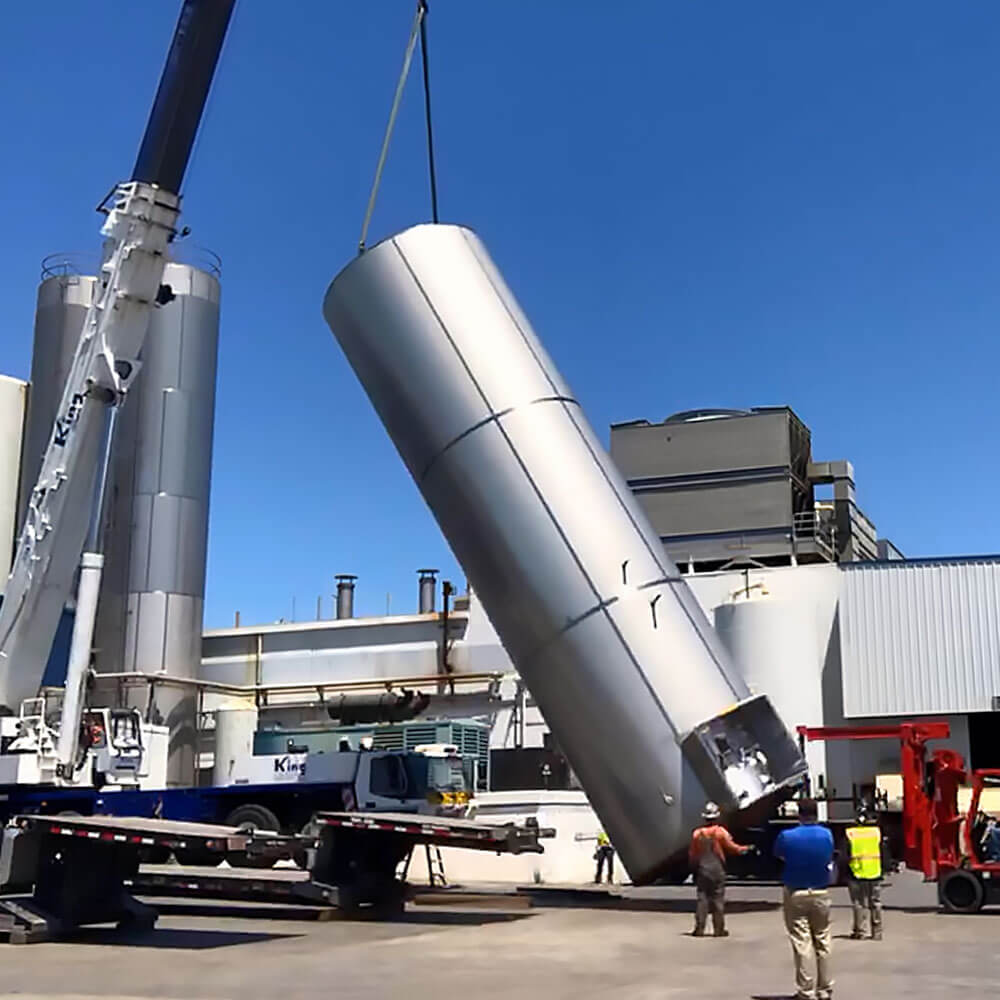
Rigging in construction and industrial settings is a specialized discipline within the Millwright trade. The scope of work for riggers includes installation, repair, maintenance, and removal of industrial machinery or construction elements.
Riggers are highly skilled tradespersons who are trained to dismantle and move large equipment or machinery.
They accomplish these tasks with an assortment of specialized tools including chains, pulleys, winches, hoists, and cranes.
Sample projects and tasks that typically rely on riggers for a successful outcome include:
- Installation of new equipment
- Decommission and removal of machinery
- Dismantle large, complex equipment into smaller, movable pieces
- Prepare large equipment or structures to be lifted by crane

Rigging Services
As mentioned above, industrial rigging services are carried out by Millwrights.
Millwrights, also known as industrial mechanics, are skilled professionals whose expertise lies in the area of installation, maintenance, and repair of machines and equipment.
Rigging Services at SilMan Industries
Rigging industrial equipment for removal or relocation is a common practice for the SilMan Millwright Team.
Their capability to fold Rigging into their overall mechanical scope of work adds efficiency to our project teams and added value to our clients.
Moreover, our Millwrights enjoy a long history of collaboration with their Electrical colleagues. This close-knit relationship is utilized by project managers to avoid bottlenecks and reduce 3rd party subcontractors. In turn, these results accrue to our client in the form of ease of communication, efficiency, cost savings, and increased up-time.
To learn more about SilMan’s M&E super-team, check out our Mechanical and Electrical pages for the whole story.
Rigging Safety
Working in industrial settings inherently includes exposure to risk. These dangers demand that service providers in these facilities create and execute comprehensive safety protocols.
However, Rigging brings a unique set of challenges to job site safety. As large equipment and structural elements are elevated and moved in crowded areas, or lifted over buildings, the threat of injury and damage to property rises exponentially.
These situations require heightened safety guidelines and operational practices. Documents such as “Job Hazard Analysis” and “Safe-Lift Plan” are core elements of industrial rigging projects, designed to meet these risks.
SilMan’s Safety Team has gathered their experiences into an article as a gift to our industrial community. The piece, titled “Best Practices for Rigging and Relocation“, details their methodology and process.
The portfolio of tools and skills of riggers are employed in a variety of environments beyond industrial mechanical applications.
Rigging and Steel Erection
Rigging is closely associated with Steel Erection. Their work is focused on lifting and installing steel members, such as columns and beams, in the course of construction of tall commercial structures.
Steel Riggers are affiliated with the Steel Workers union, a sister trade to Millwrights.
Rigging in Theatre and Film
Outside of the industrial sector, rigging tools and practices are also a common part of Stage and Film.
All positioning and movement of lights or scenery in the theatre and film are “rigged” overhead. In a theatre, the tall space above the stage is known as a fly loft, we’re items are “flown.”
As is the case in industrial settings, theatrical rigging presents safety risks to the stage technicians and performers. Therefore, certification and safety standards are similarly a part of rigging in the entertainment industry.
Not surprisingly, the origins of the rigging trade in entertainment comes from the sailing profession. Moonlighting sailors put their skills to use in local theatres when they were not otherwise employed at sea.
Rigging Certification
Here is a list of five rigging certifications from Indeed.com that illustrates the variety of Rigging career paths that are available.
Industrial Rigging is one of many proficiencies that Millwrights acquire through their training and ongoing professional development.
Within the span of mechanical skills, rigging is a unique skill and requires specialized training and certification.
What does a Rigger do?
Here is a sample job description and list of qualifications for an Industrial Rigger.
Duties and Responsibilities
- Ensure that all machinery is set, aligned, and leveled
- Attach and detach loads properly
- Communicate with all team members effectively
- Ensure compliance with all safety rules and regulations
- Monitor and maintain all rigging equipment to ensure safety
- Report all safety concerns and issues to management immediately
- Safely and properly attach and utilize all pulley and block systems
- Set up and break down necessary equipment
- Fabricate job-specific systems as needed
- Properly select gear for the job
- Maintain control of all loads at all times
- Maneuver loads through difficult and confined spaces
- Work cooperatively with erection team to meet requirements
Requirements and Qualifications
- High school diploma or equivalent
- Must be NCCCO certified Level 1, minimum
- Significant work experience as a rigger, 2+ years minimum
- Must be up to date, and willing to comply with all OSHA safety standards
- Familiar with all necessary safety equipment
- Able to assess each load and select proper equipment for the job
- Solid working knowledge of all rigging equipment
- Able to inspect rigging equipment to ensure it is in good working order
- Experience with crane assembly and disassembly
- Solid math skills for calculating load requirements
- Physically capable of working in demanding conditions
- Able to sit, stand, bend, and lift 50 lbs on a regular basis
- Excellent vision and hearing
- Not afraid of heights or climbing ladders, scaffolding, etc.
- Fluent in English; bilingual a plus
- Reliable and hardworking with a team-player attitude
Other types of rigging certifications
https://www.indeed.com/career-advice/career-development/rigging-certifications
For information about becoming a Millwright
See our article covering SilMan’s Industrial Mechanical Services.
