
Material Handling Solutions
The Strategic Role of Vertical Expansion
In high-volume fulfillment and distribution environments, efficient space utilization is paramount to profitability. As throughput demands increase, the building’s footprint often becomes a bottleneck. Mezzanine systems address this challenge directly by creating usable, elevated floor space within the existing structure.
Integrated into a facility’s conveyor infrastructure, mezzanines are far more than simple elevated platforms; they are structural components that enable operations to stack material-handling processes vertically. This strategic vertical expansion minimizes the need for costly real estate acquisition or new construction, dramatically increasing storage density and throughput capacity within the current facility.
Mezzanine systems are instrumental in organizing complex, multi-layered operations, such as separating high-speed sortation from lower-level packing or storing bulk inventory above active picking aisles. By adding vertical real estate, the system gains space for critical equipment and personnel, ensuring that square footage constraints do not limit growth.
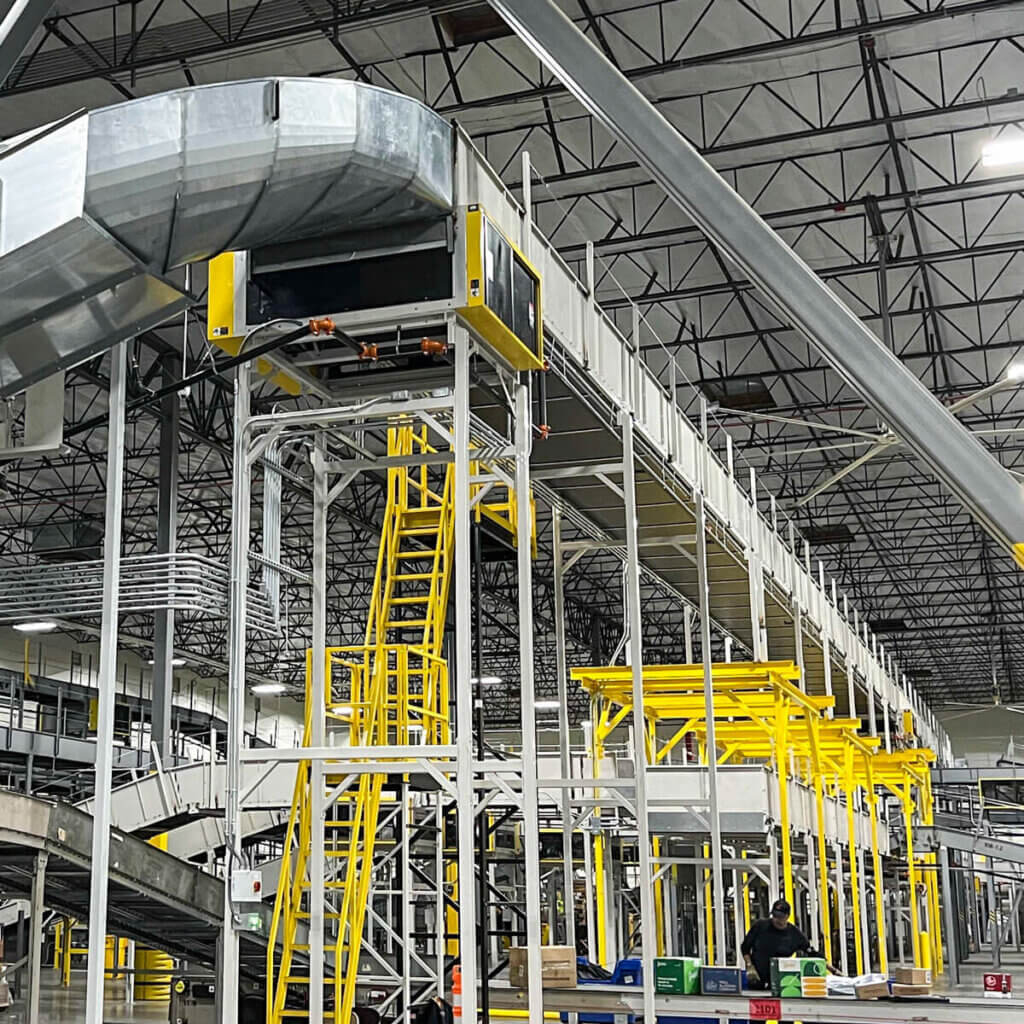
Primary System Elements
The design of a material handling mezzanine requires a structural engineering focus to ensure full integration with the conveyor and racking systems below and above. These elements combine to support continuous, dynamic loading and personnel access.
| Table System Element | Role in Material Handling Integration |
|---|---|
| Structural Steel Columns & Beams | The foundation of the system, designed to support the dynamic load of conveyors, heavy machinery, inventory, and personnel, ensuring seismic and safety compliance. |
| Decking & Flooring | The actual elevated surface, which can range from high-density particle board for light loads to steel grating or concrete decking for heavy equipment and high-traffic areas, often featuring anti-slip surfaces. |
| Vertical Conveyors & Lifts | The critical link between levels. This includes Vertical Reciprocating Conveyors (VRCs), spiral conveyors, or high-speed lifts that transfer product, totes, and pallets from the ground floor to the mezzanine and vice-versa. |
| Stairs, Landings, and Railings |
Ensures compliant, safe access for personnel. Stairways are strategically placed to minimize walking distances and are designed for industrial use, complete with guardrails and kick plates. |
| Material Gates | Designated areas on the mezzanine floor equipped with sliding or hinged gates to safely receive large items, pallets, or equipment using a forklift from the ground floor. |
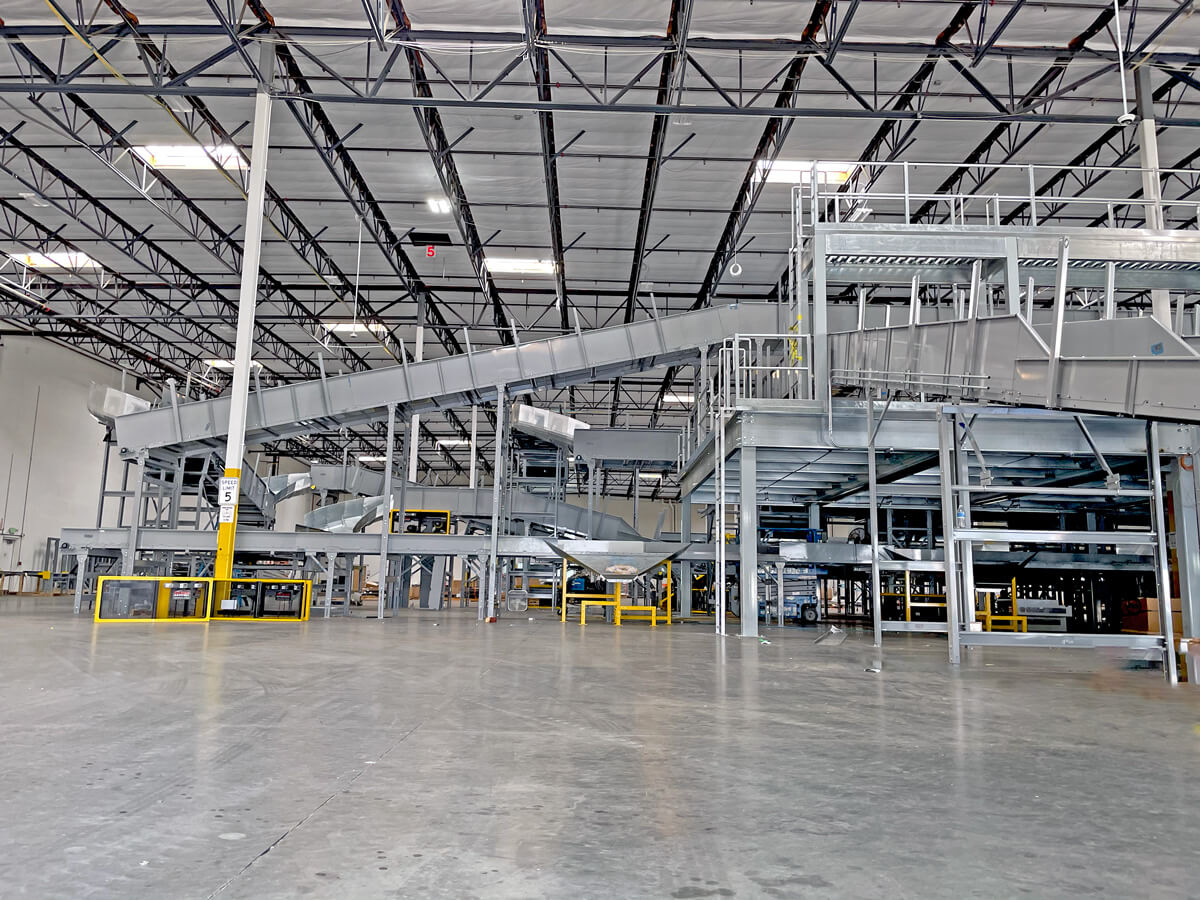
Design and Controls Features
The most sophisticated mezzanines are not just structural; they are controlled environments engineered for workflow. Their design must account for dynamic load distribution and seamless interaction between vertical levels.
- Custom Load Rating: Unlike standard office construction, material handling mezzanines are custom-engineered for specific live loads—the weight of moving inventory and equipment, not just static storage. This dictates column spacing and beam size, which must be planned around the lower-level workflow to avoid interfering with forklifts or machinery.
- Integrated Fire Safety and Lighting: Design includes integrating sprinkler systems and lighting to ensure compliance with building codes for the newly created upper and lower levels. Strategic lighting placement ensures safe visibility in dense inventory areas.
- Controls Handshaking: Vertical lifts and VRCs operate fully integrated with the facility’s Warehouse Control System (WCS). This control system ensures that transfers between levels are synchronized with the conveyor flow, preventing product jams, accumulation backups, and costly system downtime.
- Multi-Tiered Staging: Complex designs may feature multi-tiered mezzanines (three or more levels), where each level hosts a different function—for instance, level one for inbound sortation, level two for order picking, and level three for packing and shipping.
Benefits for System Performance and Scalability
Implementing an industrial mezzanine system is a proactive solution that drives operational integrity and provides a clear pathway for future growth.
- Immediate Capacity Increase (Density): The primary benefit is the dramatic expansion of usable space without increasing rent or property taxes. Mezzanines can effectively double or triple a facility’s operational footprint, accommodating more inventory, picking zones, or sorting lines.
- Optimized Workflow Segregation: Mezzanines allow operations to cleanly separate noisy, high-speed automated processes (such as parcel sortation) from quieter, labor-intensive tasks (such as packing, quality assurance, or supervisory offices). This improves focus, efficiency, and team member comfort.
- Reduced Product Travel Time: By creating direct vertical transfer points via VRCs and spiral conveyors, the system can bypass congested ground-level aisles. This shortens the product’s travel path, reducing overall order cycle time and improving customer delivery metrics.
- Future-Proof Scalability: A well-designed mezzanine platform is built for growth. It provides a foundational structure for a distribution center to install a second phase of equipment, such as a Goods-to-Person (GTP) system or additional automated storage and retrieval systems (AS/RS), allowing the facility to scale its volume capacity without structural relocation.
About the Company
SilMan Industries (previously SilMan Construction) is based in San Leandro, Calif., with Engineering and Field Operations offices in Tupelo, Miss. The firm provides integrated turnkey solutions in the Industrial, Manufacturing, Distribution, and Public Works sectors.
Notably, in 2010 SilMan Industries was contracted to dismantle and remove the NUMMI assembly line in Fremont, Calif., transport the equipment, and reinstall the system in Blue Spring, Miss., establishing Toyota Motor Manufacturing Mississippi (TMMMS). This high-visibility project ignited the company’s meteoric growth, laying the foundation for SilMan’s national service area.
For more information, please visit www.silmanindustries.com/about.

Frequently Asked Questions for Mezzanine Systems
What is a mezzanine system in a warehouse?
A mezzanine system is an elevated platform in a fulfillment or distribution center that enables material-handling processes to be stacked vertically. This creates additional floor space for storage, operations, or equipment without expanding the building footprint. It integrates structural steel beams, decking, and vertical conveyors like VRCs to optimize vertical space and improve material-handling efficiency in distribution centers.
What are the benefits of installing a freestanding industrial mezzanine over building an expansion?
A freestanding industrial mezzanine's cost-effectiveness, compared to building expansion, is one of the key benefits. The mezzanine utilizes existing vertical "airspace" without increasing property taxes or the building's footprint. Mezzanines are classified as equipment rather than permanent structures, which may allow for faster depreciation and ROI in as little as 2–3 years.
How much weight can a warehouse mezzanine floor support?
A warehouse mezzanine's load capacity is custom-engineered based on the intended use. Light-duty platforms typically support 125 lbs per square foot (PSF), while heavy-duty structural steel mezzanines can be designed to support over 500 PSF. Heavy-duty mezzanines can accommodate heavy machinery, high-density pallet racking, or automated conveyor systems.
Do industrial mezzanine systems require a building permit and seismic engineering?
Yes, industrial mezzanines must comply with local building codes, OSHA standards, and the International Building Code (IBC). In many regions, they require specific seismic engineering to ensure the structure can withstand lateral forces. Professional integrators like SilMan Industries provide turnkey services that include professional engineering (PE) stamps and permit management to ensure full compliance.
Schema
