
Material Handling Solutions
The Evolution of Material Transport in Fulfillment
The landscape of distribution and fulfillment centers is rapidly transforming through flexible automation, primarily through the deployment of Automated Guided Vehicles (AGVs) and Autonomous Mobile Robots (AMRs). These mobile technologies are essential for increasing operational flexibility, reducing manual labor costs associated with repetitive transportation, and scaling capacity without requiring changes to fixed infrastructure.
While both AGVs and AMRs transport materials, they represent two distinct generations of technology.
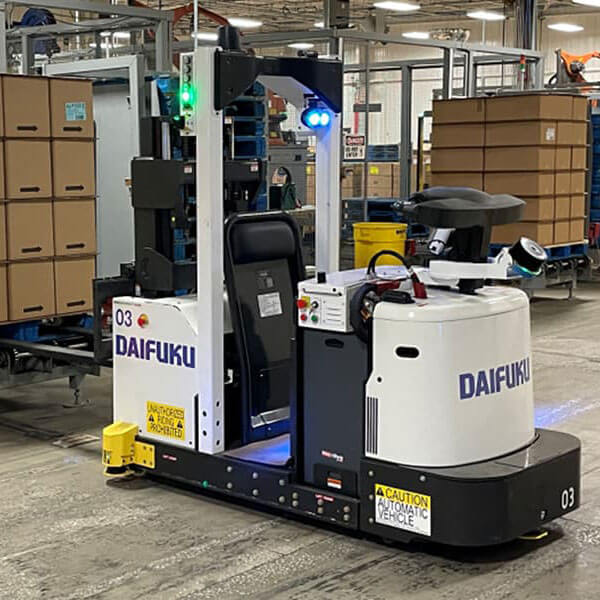
AGVs follow predefined routes, relying on physical guides such as wires, magnetic tape, or laser targets, and are highly reliable for repeatable, high-volume tasks.
AMRs, however, utilize on-board intelligence, sensors, and sophisticated navigation software to dynamically map and adapt to their environment. This flexibility allows them to safely navigate around obstacles and choose the most efficient path in real-time, making them ideal for dynamic, human-centric workspaces.
The integration of AMR and AGV solutions in warehouses can create highly efficient and scalable operations. And while some companies focus on proprietary hardware, SilMan Industries specializes in software, controls, and installation expertise to integrate a diverse fleet of mobile automation into existing facilities. We select the best-fit mobile technology, regardless of vendor, and synchronize it with your fixed material handling equipment (MHE), WMS, and ERP systems.
Core Equipment Types and Uses
The design of a mobile automation solution hinges on selecting the right vehicle type for the specific transport or operational task.
| Equipment Type | Guidance / Navigation | Primary Use in Distribution |
|---|---|---|
| AGV (Automated Guided Vehicle) | Fixed Path (Wires, Magnetic Tape, Lasers, or Vision markers) Moving heavy, consistent loads (e.g., pallet transport, sequenced | |
| Tugger/Tow Vehicle (AGV/AMR) | Fixed or Autonomous | Hauling multiple carts or trailers of components, often used for sequenced line feeding in manufacturing or long-distance floor transport in distribution |
| Unit Load Carrier (AGV/AMR) | Fixed or Autonomous | Transporting a single large item, pallet, or roll container. Commonly used for dock-to-storage or bulk transfer. |
| AMR (Autonomous Mobile Robot) | Dynamic Path (Lidar, Vision, SLAM mapping) | Collaborative, flexible movement within complex or changing environments, often used for goods-to-person operations or small-item delivery to packing stations. |
| Goods-to-Person (GTP) AMRs | Dynamic | Moving mobile shelving units or racks to an operator’s station, eliminating operator walk time for picking (e.g., systems deployed by companies like Omron Adept or Jungheinrich). |

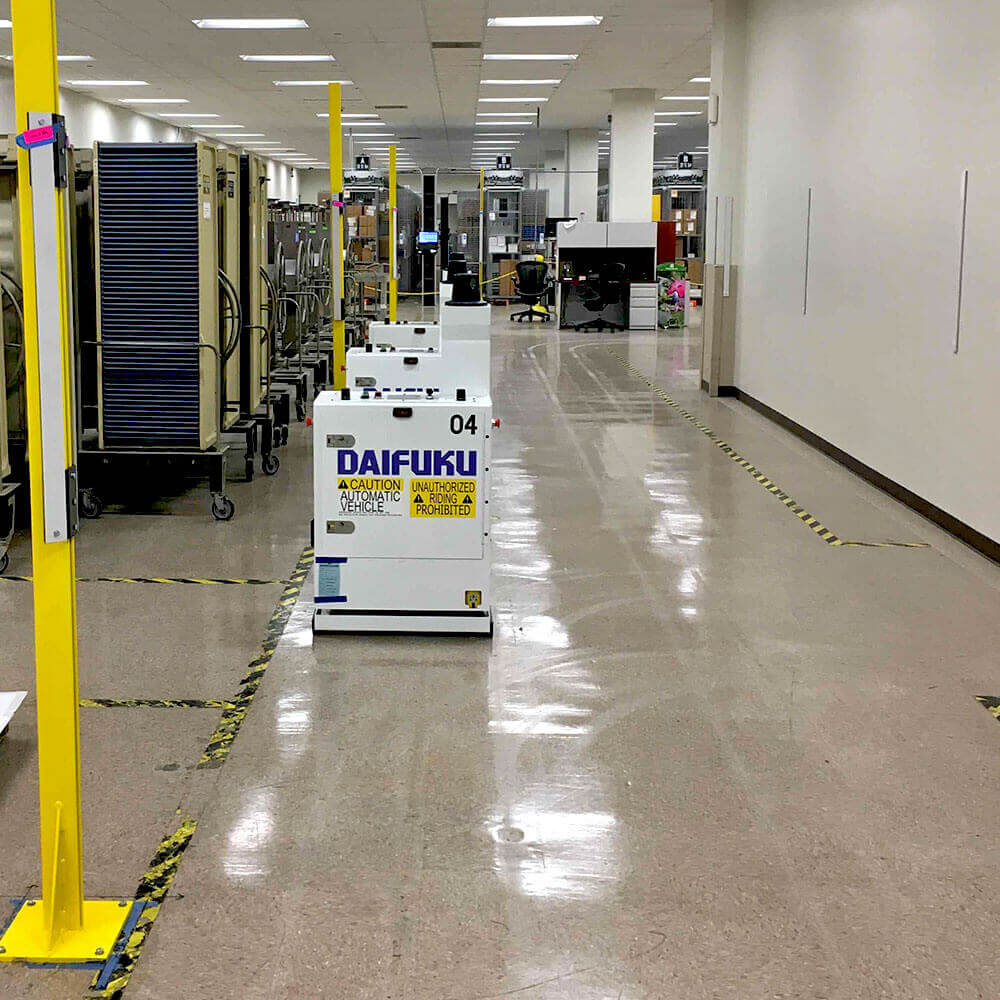
Specialized AMR Types
AMRs, driven by providers like Linde Material Handling and Bosch Rexroth, offer specialized functionalities that go beyond simple transport:
- Sorting Robots: AMRs equipped with tilt-tray tops that rapidly and flexibly sort small items (polybags, small cartons) by carrying them to a designated chute or destination zone.
- Forklift AMRs: Autonomous versions of counterbalance or reach trucks designed for automated pallet put-away and retrieval from static racking.
SilMan’s Controls Expertise: UNISON Fleet Management
The operational difference between a complex, disjointed fleet and a seamless mobile automation system lies in the Fleet Management System (FMS), often governed by a powerful WCS such as SilMan’s UNISON.
- Intelligent Traffic Management: The FMS coordinates the entire fleet, dispatching vehicles, optimizing charging schedules, and preventing conflicts by dynamically setting priority zones and ensuring continuous flow.
- WMS/WCS Integration: We ensure the WMS sends a high-level transport request (e.g., “Move Pallet A to Dock C”), and the UNISON FMS translates this into the optimal robot movement sequence. This seamless data exchange is critical for Inventory Accountability and for integrating mobile units with fixed MHE (such as conveyors and vertical storage).
- Obstacle Avoidance and Safety: AMRs use advanced sensors (LiDAR, 3D cameras) to perform dynamic path recalculation, enabling them to detect and safely maneuver around obstacles and personnel without stopping, maximizing uptime in shared workspaces.
ROI and Flexibility for Brownfield Facilities
The strategic deployment of mobile automation delivers profound operational and financial advantages, particularly for retrofitting existing “brownfield” facilities where fixed infrastructure changes are costly and disruptive.
ROI, Scalability and flexibility: AMRs offer capacity that can be increased or decreased simply by adding or removing vehicles. Since they require little to no fixed infrastructure (unlike traditional AGVs), implementation is faster, deployment costs are lower, and the time-to-value is dramatically reduced.
Improved Labor Utilization: By automating repetitive, non-value-added tasks like hauling and replenishment, mobile automation allows human team members to focus on complex, high-value activities. Furthermore, AMRs significantly reduce manual material handling, thereby improving safety and ergonomics.
Finally, the Future-Proof Flexibility of AMRs means their software-defined nature allows facility layouts and missions to be changed and redefined with simple software adjustments, providing full ownership and adaptability for long-term growth.
SilMan delivers the complete, integrated solution—from engineering consultation and vendor-agnostic selection to the final commissioning of the WCS/FMS—ensuring your mobile automation investment is ROI-justified and fully prepared for the future of fulfillment.
About the Company
SilMan Industries (previously SilMan Construction) is based in San Leandro, Calif., with Engineering and Field Operations offices in Tupelo, Miss. The firm provides integrated turnkey solutions in the Industrial, Manufacturing, Distribution, and Public Works sectors.
Notably, in 2010 SilMan Industries was contracted to dismantle and remove the NUMMI assembly line in Fremont, Calif., transport the equipment, and reinstall the system in Blue Spring, Miss., establishing Toyota Motor Manufacturing Mississippi (TMMMS). This high-visibility project ignited the company’s meteoric growth, laying the foundation for SilMan’s national service area.
For more information, please visit www.silmanindustries.com/about.

Frequently Asked Questions for AGVs & AMRs
What is the main difference between an AGV and an AMR?
The main difference lies in how the vehicles navigate. AGVs (Automated Guided Vehicles) follow fixed paths marked by magnetic tape, wires, or laser targets. AGVs are well-suited for high-volume, repetitive tasks. AMRs (Autonomous Mobile Robots) use sophisticated navigation software, on-board intelligence, sensors, and LiDAR, to map and navigate changing environments. They're capable of identifying and safely maneuvering around obstacles to complete tasks.
How do Autonomous Mobile Robots (AMRs) navigate in a warehouse?
AMRs navigate by utilizing a technology called SLAM (Simultaneous Localization and Mapping) combined with LiDAR and 3D cameras. The robot is capable of creating a digital map of its surroundings in real-time. Instead of following fixed physical guides, an AMR calculates the most efficient path and can adjust its route instantly if an obstacle is detected.
What is the ROI of implementing AGVs and AMRs in fulfillment centers?
The ROI of mobile robotics is a product of reduced manual labor costs, increased throughput, the optimization of space, scalability, and improved safety. AGVs excel at repetitive operations. AMRs provide flexibility and require no fixed infrastructure. Therefore, they offer lower deployment costs and faster time-to-value than traditional automation. Integration with a fleet management system like SilMan's UNISON optimizes vehicle charging and traffic, further maximizing operational uptime.
