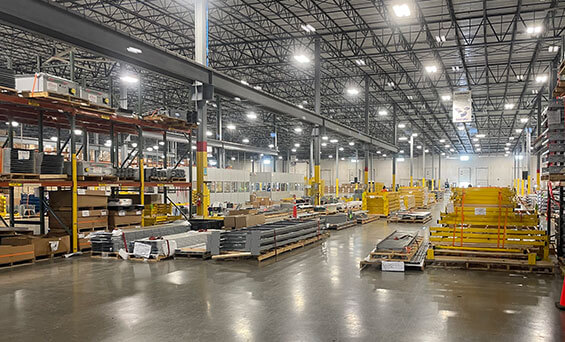
Distribution and Fulfillment Centers – Increasing Efficiency and Cost Effectiveness
3 Things You Can Do Today

Pressure on Distribution Centers
Meeting the Moment
Those of us working in Fulfillment and Distribution Centers, have all heard the news: we are living “unprecedented” times. We’ve also heard the repeated call for increased efficiency and cost-effectiveness that echo in its wake.
Normally at this time of year, we would be de-briefing from the holiday rush. Instead, most companies have been operating at holiday levels for 9 months as we have witnessed the extraordinary growth of e-commerce during 2020.
And there is no sign of that changing anytime soon.
The pandemic has shown itself to be more of an accelerator than a disruptor, and that includes the widespread move toward high-technology solutions.
Ready or not, Industry 4.0 is here. Taking steps forward requires that we have a clear idea of where we are today as well as our intended destination.
Across the board, our clients are re-evaluating their systems and seeking cost-effective improvements to meet the “new normal” of increasing online shopping long after the Coronavirus is behind us.
Competitiveness begins with efficiency. Efficiency begins with clarity regarding the challenges to be solved.
This is not a time to sugarcoat the status of your operation. In tightly competitive times, there is very little wiggle-room for unfounded “blue-sky” assessments.
Instead, now is the time to gather your team and start making an honest assessment of your current operation.
Let’s start with three things you can do now to skillfully face these “unprecedented times!”
You may also enjoy this case study.
Custom System Design for the Levi Straus Fulfillment Center, Toronto.
1. Data: Knowledge is power
To begin a journey it is imperative to know where to start. Similarly, knowing the facts about your current system’s performance is a crucial aspect of improving it.
As much as it might hurt, you and your team need to understand the details about your performance. Data is your friend.
What can I do today?
Begin planning for a System Audit.
The scope and depth of the process can vary wildly between companies and industries. However, here are a few basics:
Establish your metrics. Pick a list of data points that are important to you: for instance, sortation accuracy, throughput, lines picked per team member/per hour, orders packed per hour, etc.
Then make a promise to stick with this list next year, and the next…. The resulting year-over-year comparisons will be a priceless tool.
As you proceed, remember that honesty is the best policy. Don’t be afraid to ask the hard questions. Keep your eye on the ball and be willing to let go of sacred cows.
2. Nuts and Bolts: Back to Basics
Your inbox is full of case studies and equipment demo videos of the latest technologies.
While this roller coaster of innovation can be distracting, attaining a fundamental understanding of new solutions is essential. As a matter of fact, this article would be incomplete without discussing automation solutions (see #3 below).
However, for as much as these innovations shape our long-term planning, the basics of our craft have not changed.
For instance, a strong facilities maintenance program is the cornerstone of your ongoing productivity.
The condition of your current equipment is a key aspect of justifying future upgrades. The comparative ROI on new technologies is only as good as the baseline. (see Tip #1)
What can I do today?
Review maintenance and safety incident records.
What time-sensitive situations is your maintenance team consistently responding to?
Review Down-Time reports for the year:
- Is there a wear-&-tear pattern for key components?
- Are you keeping records of parts purchased?
- Did you have to wait for any key parts to arrive? What was the cost?
Challenge your maintenance team to develop a Maintenance and Spare Parts Strategy. Dig deep into your upcoming projects and equipment specs and develop an action plan to maximize Performance and Up Time.
3. Technology
Like it or not, change is the new normal for the supply chain, and the fulfillment and distribution centers that power it. And today more than ever, technology is shaping the way our workplace functions.
The worst decision one can make is to ignore trends and continue with a “business as usual” attitude. And of course, the second-worst decision we can make is to latch onto every new gizmo that is released.
The key is to strategically identify key technologies to keep your facility on a path toward continual improvement in a cost-effective way.
What can I do today?
Identify publications and industry groups that relate directly to your function and industry.
Discipline yourself to set aside time to read and browse articles. Stay educated about trends and track the adoption levels of particularly relevant equipment.
Keeping up with industry trends and understanding advances in software and hardware has now become a basic element of leadership.
The Role of Integrator Partnerships
Distribution centers at the crossroads: Repair or Replace?
By sharpening your business objectives and gathering data, you will empower yourself to discern the value of high technology solutions.
And that’s where your industry network can provide the most value.
Some team members are found inside the walls of your facility. Others are 3rd party relationships that can provide up-to-the-minute insights into specialized solutions and how they can multiply your investment.
Relationships require trust. Trust requires time. Now is a great time to reach out to your vendor community to create a network of personal resources.
- Anybody can use Google. Real professionals get on the phone and call a professional.
Don’t just add a vendor, multiply a relationship
From our vantage point, most clients bring Integrators onboard far too late in the process. Once a project has gone out for bid, the customer has skipped the opportunity to look at the project from a global perspective: to reflect on available solutions in light of your over-arching business goals.
This is the place where magic is found, and where SilMan shines the brightest.
Need a little help getting started?
Reach out to David Rebata anytime for a free personal consultation. This will allow us to better understand your operation and we can introduce our team to you.
About SilMan
SilMan Industries (previously SilMan Construction) is based in San Leandro, California.
Founded in 2008, the firm operates nationwide in three divisions – Construction, Material Handling and Site Services – and partners with “best in class” companies in the Industrial, Manufacturing, Distribution, and Public Works sectors.
For more information, please visit www.silmanindustries.com/about.