More Than a Robot
What is Automation?
As I write this article, I am employing automation. I am capturing and formatting text on a device that stores and organizes this document in relationship with my other documents. This machine will also allow me to distribute the document to multiple destinations around the world with a click of a few buttons at nearly-zero cost.
- Time savings, reduction of costs, streamlined process, improved inventory control
We hardly remember all of the automated elements which, until very recently, were completely manual.
- purchase and storage of paper, pens, ribbons and envelopes, managing these elements throughout the “production” process, and finally the complicated distribution of multiple copies by mail – stuffing and addressing envelopes, and engaging with postal or courier services (and the accompanying costs).
From today’s perspective the technical revolution of the Fax Machine seems positively prehistoric!
I offer this example to demonstrate that while we have been struggling with many topics in our industry over the past few decades, the seemingly small “automation” of our document production technology has fundamentally changed our working environment. In automation, the little things matter.
As I interact with clients and prospects in the Logistics and Material Handling space, the rush to focus on robotics often overlooks simpler and less costly “Continuous Improvements” to current designs that could be easily implemented.
Back to Basics
The term “automation” is first recorded in 1945 as a mash-up: autom(atic) + (oper)ation.
“the technique, method, or system of operating or controlling a process by electromechanical devices, reducing human intervention to a minimum.”
Like our automated modern-day writing solution, we are surrounded by opportunities to innovate every day.
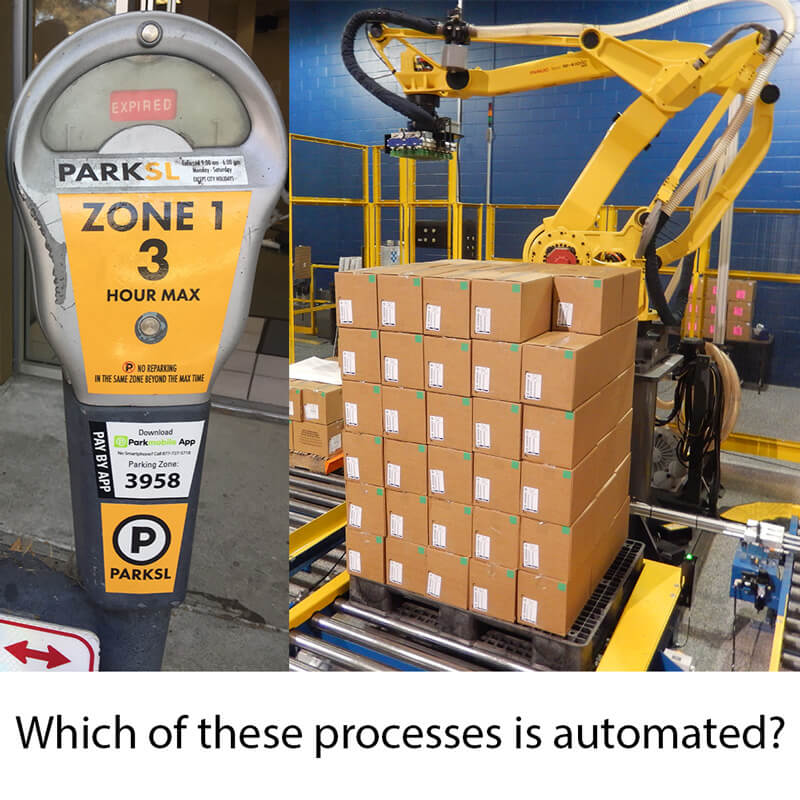
Recently, I was amused to see the parking meter automation pictured above.
They didn’t automate the meter itself, they created a simple mobile app to record payments and indicate to parking authorities that the car identified in the app is legally parked. The only update required on the front side of this automated process was a sticker on the meter itself.
Not very sexy, but the solution has made life a lot easier for customers and city officials alike.
How to Identify Potential Automation Opportunities
Let’s start with the “Why.” What are the typical pain points that drive automated solutions?
- Lack of willing labor
- Dangerous tasks
- Costly process
- Repeatability
- Precision
- Space constraints
First Steps: identify opportunities. Looking at this common list of challenges, the potential for making incremental improvements could be at your fingertips.
Second: forward progress begins by having strong financial and operational strategies. Without these benchmarks there is no way create a realistic ROI justification for a proposed solution.
Third and most importantly, this is a great time to consult with a professional integrator.
Unfortunately, this third step often gets overlooked. Ideas are formed, plans created and the project goes out for bid without insights from the very professional that the business is relying upon to create the solution.
From where I sit, the single-most repeated phrase we hear on new projects is: “I wish we had talked to you before we got to this point.”
So, how to identify areas of effective automation opportunity?
- Start with the end in mind (with a nod to Stephen Covey!), and bring in a professional. Our business as an integrator is fundamentally about saving money, not spending it.
How much does it cost get into automation?
 Not surprisingly, we get this one a lot these days. And of course, the answer is “it depends.”
The genesis of this article came from a recent conversation with a client, when I realized how much this is simultaneously a simple and difficult question. We began by talking about the specific process he had in mind to automate, and a robotic solution he had read about online.
It’s always a good idea to exercise caution about what you read about online. An ideal solution for one company may not be appropriate for you.
Secondly, let’s face it, when most people think about “automation” and ask me about costs, they are actually thinking about robotics.
Typically, we visualize an automobile chassis rolling through the robotic weld-up phase, or a robotic arm holding steel parts against a grinding wheel.
These examples are highly specialized tools to complete specific tasks. And just like we are asking you to do, these machines were deployed in response to specific challenges, and the solution was crafted around the company’s overarching goals.
“Aw, C’mon, Ron. Just answer the question. What does it cost?”
Ok, ok! The answer is based on the opportunity cost of not automating. If a producer could get three shifts worth of output for a monthly automation lease payment of less than or equal to the cost of staffing and supervising that position, it would be a strong consideration.
Moreover, there are long term implications.
“Case Study: In the case of robotics, imagine your cost structure after the automation is paid for. Here at SilMan, we dismantled an entire automotive assembly plant a few years ago. Hundreds of robots were removed and transported to the new plant. The age of those robots was well past their payback period, and we installed and re-commissioned every one of them.
We see this reality in daily life all the time. Heck, I drive a 22-year-old car that is in incredible condition…and paid for!
Similarly, consider the impact of automated storage solutions. Small parts to surgical supplies, even entire pallets, can be managed in less space and with fewer touch points to reduce their cost of handling. The net benefit is near total control over an inventory.
And don’t forget Automated Guided Vehicles… (yes, even the humble forklift has a target on its back)
Next Steps

Remember, automation is a huge category; robots just happen to be the shiniest solutions out there. The world of “Automatic-Operations” has been unfolding since the first assembly line was developed to build Model T’s! The breadth of innovative, cost-savings solutions is expanding every day.
Finding the right partner will help you put the pieces together: that is, an experienced integrator who is working to earn your business not just trying to sell you something.
Nurturing this relationship is a great way to keep up with the pulse of the industry and as a knowledge resource for your team. A trusted partner can bring experiences from a wide variety of industries, offering you up-to-date solutions to overcome challenges and build a long term plan of continuous improvements to efficiency and profitability.