Product Review
FANUC Robots for Manufacturing Systems:
FANUC M-20iD/25 and 3DV/600
Summary:
The SilMan Material Handling System Integration team partners with FANUC robots for manufacturing applications, as well as fulfillment and distribution facilities.
In this article, we offer an overview of a manufacturing project along with team member commentary regarding specific aspects of the FANUC equipment that contributed t the project’s success.
When discussing outstanding equipment such as a FANUC robot, it is easy to fall into a stream of compliments about its performance and lose sight of specific details when discussing tools of our trade.
We will do our best to avoid this trap…however, these robots ARE amazing, and a pleasure to work with!
FANUC Robots for Manufacturing
Implementation and Integration
SilMan recently completed a robotic material handling system for a leading manufacturer. With this experience so close to our rear-view mirror, we decided it was a good time to offer insights regarding the value of FANUC robots for manufacturing.
For this project, we deployed FANUC M-20iD/25 robots utilizing FANUC iRVision, specifically the FANUC 3DV 600.
We will reflect on our experience with this equipment as a professional integrator and its impact on our client’s operation.
“Tommy says”
The format of our review will follow the journey of the product parts through the system. Along the way, we will intersperse comments from team member Tommy Ethridge as he reflects on the impact of specific FANUC products on the system.
Looking for a Deeper Dive?
As with any piece of equipment in a material handling system, the highest value derived from the machine comes from its interaction with other elements within the facility, i.e.; system integration.
Pick & Place and Inspection
FANUC Robots for Manufacturing & Assembly
Let’s get into the details of our client’s new system!
SilMan was engaged to provide a conveyance and control system for a series of manufacturing processes. The system is intentionally a hybrid of robotic automation and human operators.
When the project was in the quoting phase the FANUC M-20iD/25 was newly released to replace the M-20iA/20. The new iteration increased payload and increased at each axis, which made this robot the perfect fit for our application.
This equipment was an integral aspect of the customer’s part-handling system
Equipment and Integration
Tommy says:
“We deployed four FANCU M-20iD/25 model robots for this new system. The system required a six-axis robot with highly repeatable accuracy and speed to meet the demanding cycle time requirements. Additionally, the parts to be handled required a payload up to 10kg, not including the end of arm tool (EOAT). All of these improvements made the M-20iD/25 was an easy choice for this project.
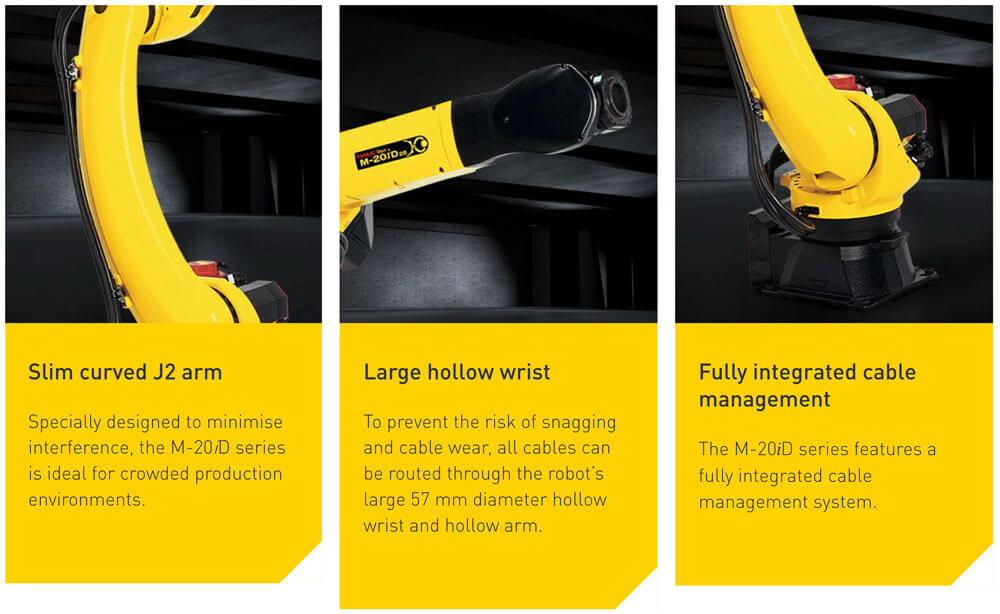
Another key feature that impacted the success of our equipment integration is the new hollow wrist feature. This update for FANUC M-20iD/25 was a huge benefit for the routing of our cables to our servo-driven endo of arm tools and make for a really clean installation at deployment without several cable dress-out brackets.”
Space Savings Features of the M-20iD/25
Tommy says:
This snippet from FANUC’s product materials is right on the money. Given that this project expanded the client’s capacity, the physical footprint and space-saving features of the M-20iD/25 were crucial for maintaining usability and safety in areas near the production line. (Photo credit: FANUC)
Induction, Pick and Place
In this system, the parts are manually de-packaged and placed onto a conveyor.
The conveyor rate throughout the system is 17 parts per minute, 3.5 seconds each.
FANUC M-20iD/25 picks and identifies via bar code and orients part in uniform position for scanning and printing.
Tasks and Capabilities
Tommy says:
“Three of the four robots deployed utilize vision to ensure the location of the parts and picking accuracy while being able to achieve a cycle time of 3.5 seconds per part. We selected the FANUC 3DV 600 sensors for the ability to provide a Z-axis reference for the parts along with the X and Y axis for picking.
Despite the 70ms exposure time of the 3DV 600, we decided to safeguard the reliability of the system in the unlikely case that the picking arm camera were to be unable to acquire the image.
Instead, based on our 3.5 second cycle time, all cameras were mounted in a fixed position over the conveyors one index position ahead of the picking location and utilized line-tracking software to locate and pick the parts.
The cameras integrated seamlessly with the M-20iD/25’s and the machine learning feature that is incorporated into the setup is an impressive feature and was very easy to use.
The overall integration with the FANUC robots and control system made 3DV 600 a slam dunk for our client.”
You may also enjoy this article:
Infeed and Outfeed
Each part is indexed on the infeed and outfeed conveyors. Robots and scanners identify parts, placing the part on a belt to be advanced through the system or diverted to a reject line.
Rejected items return to the operator for manual inspection and re-induction if approved.
Unload robots inspect parts as they depart each station. As with the infeed/outfeed operations, approved items are transferred to the next sequential operation in the system, and rejected parts are returned to the operator.
In the event of a stoppage downstream, load robots continue to load the upstream belts until the belt is full, based on part size.
The system also provides an upstream indexing buffer conveyor for unloading robots to place parts on the indexing belt away from the robot. Buffered parts are then reversed back into the pick and place zone when the line is clear.
Flexibility for Mixed Part Production
Tommy says:
“The FANUC robots were a perfect partner for the SilMan’s custom end-of-arm-tool solution. The wide range of part sizes in our clients operation required flexing for changing diameter, height, style (round, oval, racetrack), as well as orientation and positioning for 2D printing. This programming also applies to printers themselves for barcode format and location.
There were no limits to our controls design team to create unique Recipes for each part. With the additional power of FANUC’s machine learning tool, these processes are increasingly easier to modify in the future.
No operator intervention or reset of equipment is required since the EOAT provides automatic adaption for size and shape when changing product or parts.”
Refinement
The FANUC M-20iD/25 refinement robot will pick up the part utilizing FANUC 3D Vision from the end of the extended plug check machine and rotate the part in front of two opposing scanners to locate the existing code before rotating the part for the refinement camera.
The robot will perform a final rotation with the part based on the refinement camera and the robot will place the part on the pack-out conveyor in the proper orientation for laser printing,
The laser printer stand will be equipped with a servo drive to move the laser in the Y-axis to print anywhere on the part.
After the laser printer, parts will be graded and scanned on the indexing pack out conveyor. Parts will continue to index through where the parts are face stamped, verified, and labeled as required by the part’s recipe. Rejects will be picked by the FANUC M-20iD/25 and placed onto the reject conveyor.
Final inspection and palletization are completed by a human operator.
Camera Setup and Integration
Tommy says:
“The FANUC 3DV600 offers a seamless link to the M-20iD/25 as no additional hardware was required to the connect the camera to the controller.
Furthermore, because the camera is FANUC, it didn’t require any third-party software or complicated programming language to translate from the camera to the robot.
This was a great outcome for our deployment team and for the end-user.
As these cameras were new at the time, we looked into other options by well-known vision providers. However, no other cameras would have integrated as effortlessly into the robots and the overall system as easily as these did.”
Final Thoughts
There is only one way to close out this article…
Why Choose FANUC robots for manufacturing and assembly?
Tommy says
The answer to this question is the same as it would be in any other circumstance.
Why choose FANUC for warehouses?
Why choose FANUC for palletizing?
It goes without saying that these robots can perform the work, and they are ROI justifiable.
Above and beyond everything we’ve said in this article, the best part of being a FANUC Authorized System Integrator, ASI, is the unwavering support network that FANUC offers to ensure project success.
FANUC’s history of unflinching support for their partner-integrators like us, and our clients, gives all parties the confidence needed to make the investment.
About SilMan Industries
SilMan Industries (formerly SilMan Construction) is based in San Leandro, California, with Engineering and Field Operations offices in Tupelo, Mississippi. The firm provides integrated turnkey solutions in the Industrial, Manufacturing, Distribution, and Public Works sectors.
Notably, in 2010, SilMan Industries was contracted to dismantle and transport the NUMMI assembly line in Fremont, Calif., transport the equipment, and reinstall the system in Blue Springs, Miss., establishing Toyota Motor Manufacturing Mississippi (TMMMS). This high-visibility project ignited the company’s meteoric growth, laying the foundation for SilMan’s national service area.
For more information, please visit www.silmanindustries.com/about.

Integrated Material Handling Solutions
The SilMan System Integration team provides conveyor equipment and automation solutions to industry-leading companies in multiple sectors across the US. The company has built this reputation on the unique insight and value delivered on every project. These outcomes begin with a deep understanding of overarching business objectives, enabling the identification of the highest-value course of action. Specializations include distribution center optimization for the Fulfillment and Parcel sectors (see “A Comprehensive Guide to Efficient Parcel Handling Systems”), food and beverage manufacturing, warehouse solutions, and end-to-end innovative manufacturing solutions.
Frequently Asked Questions for FANUC Robots for Manufacturing
What are FANUC robots used for in manufacturing?
FANUC robots, like the M-20iD/25 model, excel at tasks such as pick-and-place operations, material handling, and quality inspection. Integrated with vision systems like the 3DV/600, they enable precise part orientation, conveyor indexing, and hybrid human-robot workflows. This use of FANUC robots boosts efficiency in industries like food/beverage and distribution, achieving cycle times as low as 3.5 seconds per part while minimizing errors.
What is the primary benefit of the FANUC M-20iD/25 hollow wrist design for manufacturing?
The M-20iD/25's hollow wrist feature is a crucial update for system integration, allowing for the internal routing of cables to the End-of-Arm Tool (EOAT). This results in a significantly cleaner installation, which in turn saves valuable physical space near the production line. In addition, the hollow wrist design simplifies long-term maintenance by protecting the cables from wear.
How does the FANUC 3DV/600 vision system simplify integration compared to third-party cameras?
The FANUC 3DV/600 is specifically designed for a seamless, plug-and-play link directly to the M-20iD/25 robot controller. This eliminates the need for additional external hardware, complex third-party software, or complicated programming language translation, which greatly speeds up deployment and ensures reliable performance for the end-user.
What is the long-term value of working with a FANUC Authorized System Integrator (ASI) like SilMan?
The primary value lies in the unwavering support network and deep expertise that comes with an ASI partnership. This ensures the robotic system is correctly engineered and integrated with existing facility infrastructure, maximizing the Return on Investment (ROI) and providing the client with the long-term confidence and support needed for automation success.