
Street-Level Subway Entrances:
A SilMan Industrial Construction Pilot Project
CLIENT
Bay Area Rapid Transit
INDUSTRY
Public Works / Transportation
PROJECT SCOPE
Construction of two secure street-level access points for subway stations; Project Management, Structural, Civil Construction, Mechanical, Electrical
LOCATIONS
San Francisco, Calif.
Public Works with Bay Area Rapid Transit
SilMan Industries provides national programs for leading companies across multiple industries, including manufacturing and distribution. Coordinating large-scale programs requires excellent communication, consistency, and trust between partners. Before a program launches, SilMan’s Specialty Trade Services frequently serves as a partner for pilot projects to affirm concept design and constructability. These unique projects rely on SilMan’s lean organizational structure, in-house capabilities, and transparent processes to provide efficiency and responsiveness during complex builds.
The Bay Area Rapid Transit (BART) Canopy Project serves as an ideal example of SilMan Industries operating as a pilot project partner. For this undertaking, SilMan constructed street-level subway access canopies for two (2) street-level subway entrances in downtown San Francisco. The scope required structural, civil, and electrical services to provide an overhead structure connecting sidewalks to the underground train platforms via an escalator.
The successful outcome required close collaboration with multiple municipal agencies, flexibility to address changes and discoveries during construction, and meeting an ambitious schedule. SilMan’s unified team of in-house experts in engineering, project management, and skilled trades was uniquely positioned to meet these challenges through streamlined communication and rapid adaptability.
Let’s dive into the BART project to understand how SilMan supports their clients during pilot projects.
Project Background & Objectives
The BART Canopy Project involved renovating two street-level subway entrances in downtown San Francisco. SilMan partnered directly with BART and worked with several other public agencies including the San Francisco Municipal Transportation Agency, and Public Works.
The project required two years to complete. Scope of work included:
- Construction of secure canopies over the subway entrances
- Structural steel, concrete, electrical elements
- Escalators and roll-down gates
- Connect sidewalks and train platforms to the new entrance
Speak to a key team member on this project

Meet Tom Mangin
For more information about this project or related topics, contact Tom by email or call directly at 925.984.8992
You may also enjoy this article
Importance as Prototype
BART’s key goal was to use this project to create a benchmark for the remaining 19 stations. They wanted SilMan’s feedback on the effectiveness of the design and the construction process. As a pilot, SilMan needed to provide recommendations on cost, timing, buildability, and other factors that could inform future iterations.
Many of SilMan’s industrial and fulfillment clients also rely on pilot projects before launching large, multi-site national programs. This project exemplified SilMan’s unique ability to deliver an exceptional pilot while navigating the intricacies of public agencies.
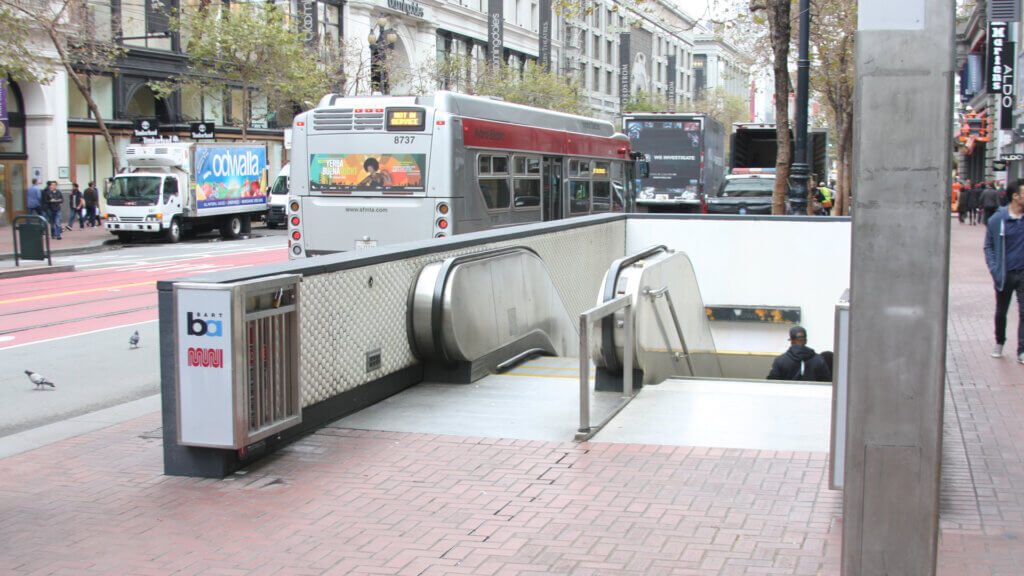
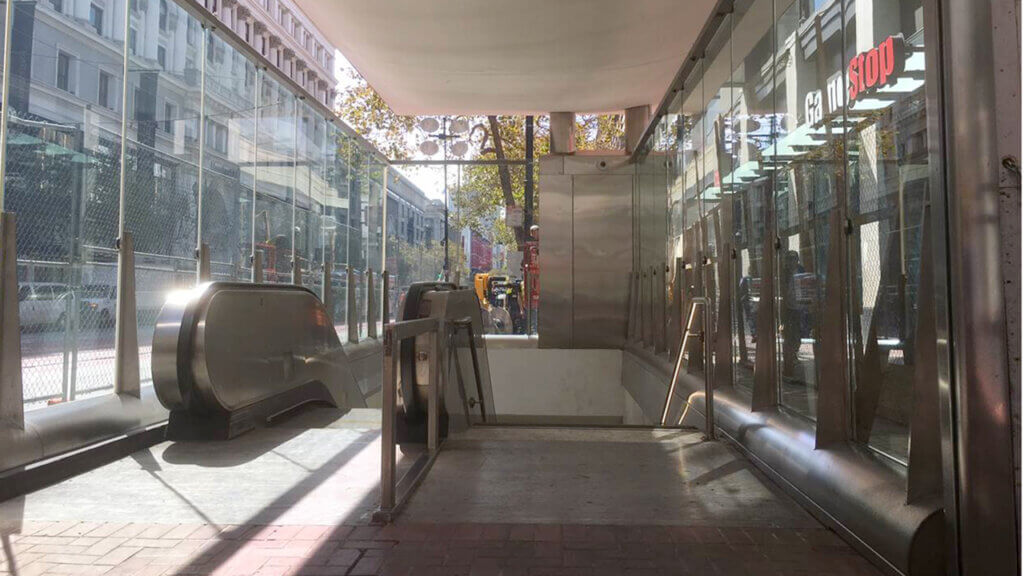
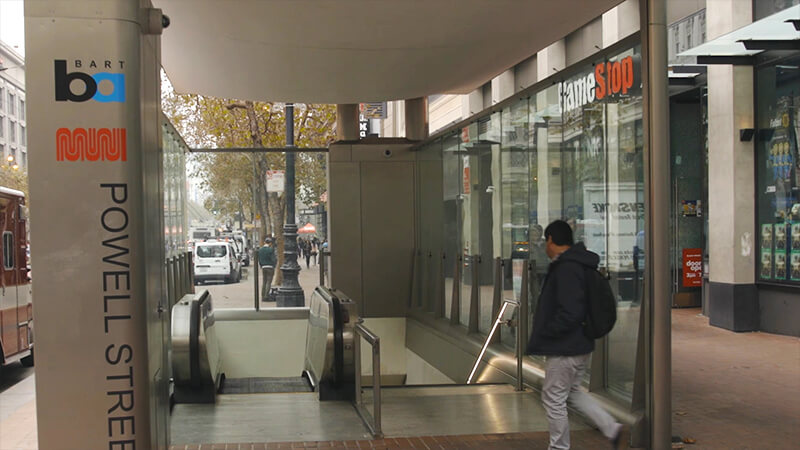
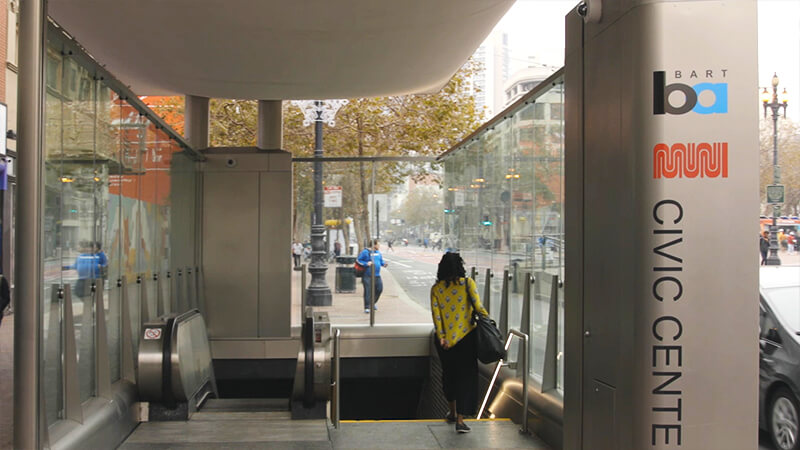
Powell St. Entrance, Before and After.
Industrial Project Management for Multiple Skilled Trade Teams
SilMan took a lean, unified team approach to manage this complex project. Rather than outsourcing different components, SilMan leveraged its in-house expertise in civil, structural, electrical, and other key areas. With all experts under one roof, SilMan could respond rapidly while keeping big-picture goals and tradeoffs in perspective.
Specifically, SilMan deployed in-house engineering, project management, and skilled trades throughout the project including:
- Project management
- Civil and structural engineering
- Civil Construction – Excavation
- Ironworkers
- Carpenters – Millwrights
- Masonry
- Electrical
Nimble decision-making
This integrated structure enabled nimble decision-making essential for the project’s tight timeline and shifting dynamics. With one centralized team controlling design, engineering, and construction, adaptations could be made mid-stream without extensive review processes. The entire team could work together to handle unexpected issues throughout the project.
Streamlined Communication
SilMan’s unified team allowed straight-line communication from executive leadership to field technicians. Constructive feedback flowed freely across the single organization rather than through chains of command across multiple vendors. This tight coordination drove efficiency while keeping the multi-layered public-agency stakeholders in the loop.
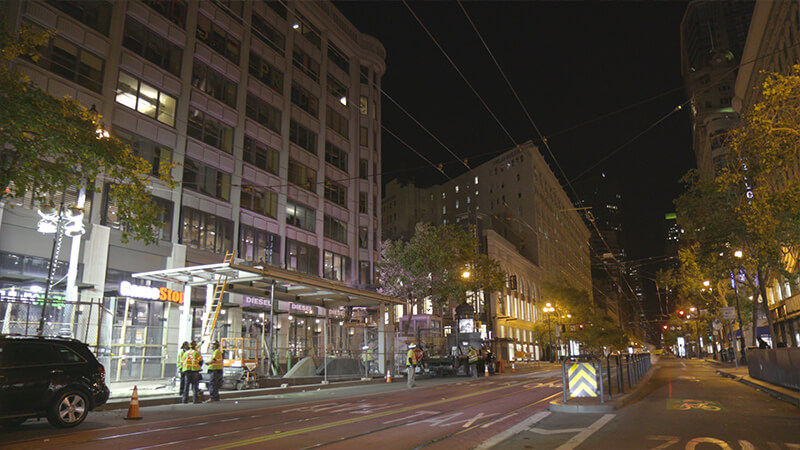
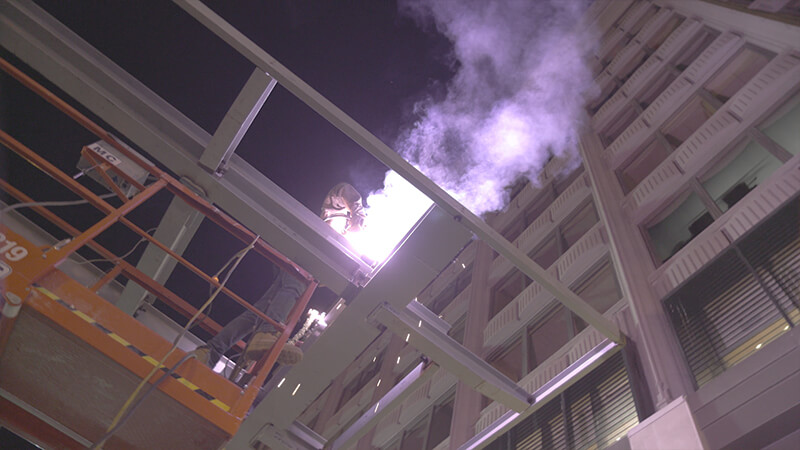
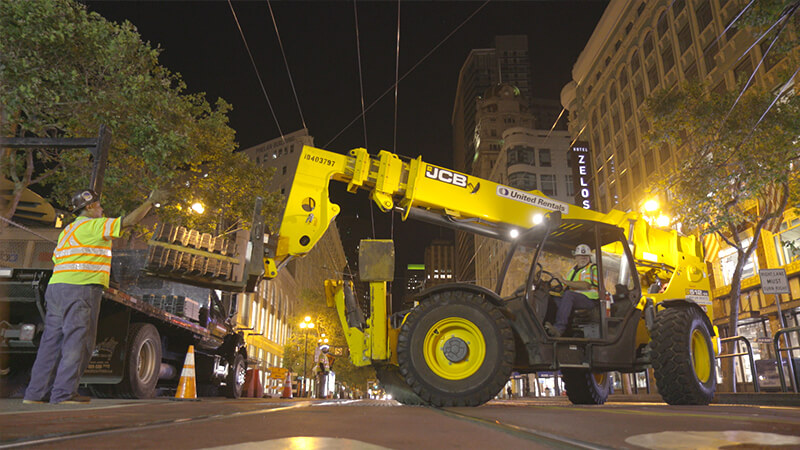
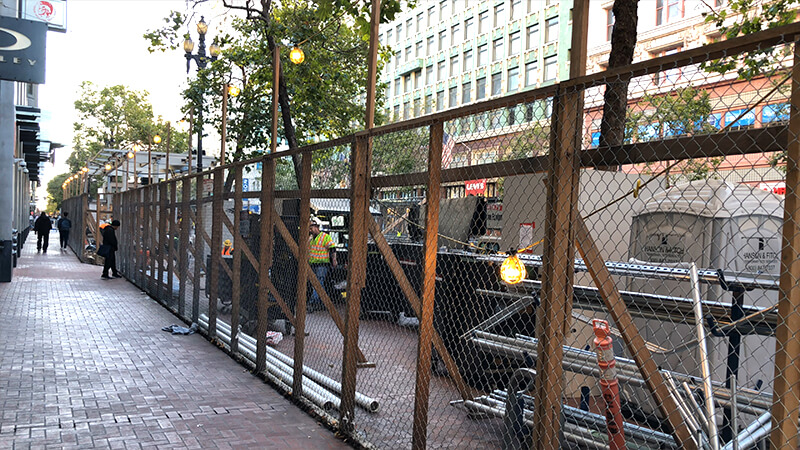
Views of the Powell St. site. Primary construction activity occurred at night.
Challenges for Industrial Site Management
From day one, the project faced public safety requirement changes from local fire and police departments that halted initial site preparation. As the project continued, the team needed to adapt on-the-fly to ongoing inputs from multiple municipal agencies and their associated approval processes.
SilMan’s integrated structure was crucial in responding rapidly to these agency impacts while minimizing delays. The team could adapt site designs, engineering plans, and construction timelines in an agile fashion to satisfy stakeholders without losing momentum.
Night Work
The complications of industrial work in an urban environment required that the primary work be executed at night. Shifts ran from 10 pm to 5 am, which required the crew to live nocturnally for 14 months. Moreover, security measures added extra hours to the beginning and end of each shift, reducing productive hours.
Nonetheless, project management, site teams, and coordination continued by day creating a 24-hour-a-day work cycle.
The daytime Trade team supported the project by handling electrical terminations and troubleshooting that could only take place during the day.
SilMan team members also directed training of new systems, devices, sensors, interlocks, and system controls with BART’s internal teams, and met with station agents, maintenance personnel, and shift supervisors.
Discoveries during construction
Additionally, the downtown San Francisco location meant excavation uncovering decades of civic infrastructure and previous buildings in various states of abandonment or disrepair. The SilMan team continually adjusted designs, schedules, and work plans as these legacy elements emerged.
For example, locating a water line shutdown valve led our team on an Indiana Jones-esque quest through subterranean tunnels and behind a mysterious plaster wall deep in the BART station basement.
Efficiency and Value from Self-Performance
Handrail Replacement
The original site plans specified reusing existing handrails. However, constructability assessments found these handrails no longer met modern safety codes. Typically replacing these would require redesigns, new vendor contracts, subcontractor coordination, and months of potential delays.
Instead, SilMan’s night shift crew rapidly fabricated and proposed a new handrail design overnight. The solution was approved instantly and installed the next day, preventing what could have been a severely impactful discovery.
Collaboration & Partnership
To succeed, SilMan needed to extend beyond a transactional contractor role to an authentic partner. The team consistently aligned decision-making with a deep understanding of BART’s key outcome goals like cost containment, scalability, and safety. This client-centric priority guided win-win resolutions as unpredictable situations surfaced.
Open communication and transparency
Fostering this collaborative dynamic depended on open, transparent interactions at all levels. SilMan hosted open houses for BART representatives to inspect designs. Field teams logged issues in real time. Leadership organized frank progress discussions rather than whitewashed status reports. This cultivated trust and familiarity within the unified project team.
Civic-minded perspective
Further enabling alignment, SilMan’s crew brought a civic-minded commitment to the project. They recognized BART’s essential role in serving Bay Area residents including their team members. This primed collaborative problem-solving when challenges emerged to avoid impeding a valued community asset.
Successful Pilot Leads to Expanded Program
The BART Canopy Project achieved all the hallmarks of an exceptional pilot. SilMan delivered the working prototype on budget and schedule while providing invaluable feedback on optimization for future stations. This clear proof of concept directly enabled BART’s board to approve a broader station entrance renovation program.
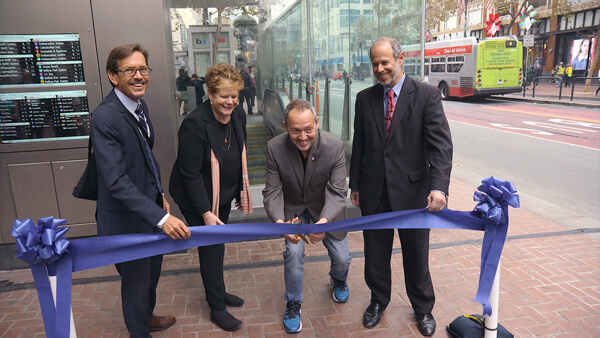
Throughout construction, SilMan’s unified structure enabled efficient coordination and buildability. The team rapidly responded to challenges, tightened decision chains, and maximized construction productivity through self-performed work. This pilot showcased SilMan’s unique problem-solving abilities that translate directly to client savings.
Most importantly, SilMan and BART emerged from this project with a partnership mentality that exceeded traditional client-vendor relationships. Aligned priorities, transparency, and civic purpose enabled the flexibility and responsiveness imperative to address fluid dynamics inherent in pioneering new infrastructure. This collaborative foundation strengthens the potential for partnering on BART’s ambitious slate of station renovations to come.
About SilMan
SilMan Industries (previously SilMan Construction) is based in San Leandro, Calif., with Engineering and Field Operations offices in Tupelo, Miss. The firm provides integrated turnkey solutions in the Industrial, Manufacturing, Distribution, and Public Works sectors.
Notably, in 2010 SilMan Industries was contracted to dismantle and remove the NUMMI assembly line in Fremont, Calif., transport the equipment, and reinstall the system in Blue Spring, Miss., establishing Toyota Motor Manufacturing Mississippi (TMMMS). This high-visibility project ignited the company’s meteoric growth, laying the foundation for SilMan’s rise as a national service provider.
For more information, please visit www.silmanindustries.com/about.
Optimize Your Investment
SilMan’s multi-disciplinary Specialty Trade Services (STS) is a community of project professionals: Engineers, Project Managers & Coordinators, Trade Teams, and Safety Management. Bringing a new performance standard throughout the industrial community:
STS commonly supports the SilMan System Integration group. Specializations include distribution center optimization for the Fulfillment and Parcel sectors (see “A Comprehensive Guide to Efficient Parcel Handling Systems”), food and beverage manufacturing and warehouse solutions, and end-to-end innovative manufacturing solutions.
Check out SilMan’s “One Team” approach in action: Facility improvements and a new bottling line at a leading West Coast dairy.
Frequently Asked Questions for BART Subway Entrance Project
What is a construction pilot project, and why are they used for public transit infrastructure?
A construction pilot project is a full-scale prototype used to validate the design concept, affirm buildability, and provide essential feedback on the construction process and cost and before a full program rollout. Public agencies like BART, as well as many industrial and fulfillment companies, use them to minimize risk on large-scale, multi-site infrastructure renovations.
How does SilMan manage the challenges of industrial construction in a dense urban environment?
SilMan uses a "unified team" approach with in-house experts in civil, structural, and electrical trades. This self-performance capability ensures streamlined communication and enables rapid on-site adaptation of site designs, engineering plans, and construction timelines due to ongoing input from municipal agencies and their associated approval processes.
What unexpected challenges are common during public works excavation in San Francisco?
Excavating in dense downtown areas frequently uncovers legacy civic infrastructure and abandoned building foundations. This requires the construction team to rapidly adjust designs, schedules, and work plans on-site, making an integrated, agile team structure essential to avoid severe delays.
