Be Cool!
Heat Stroke is No Joke

Heat Stress In Construction Environments: How To Prevent Heat Illness
It’s summertime, and for those of us in the industrial sector, we have entered one of the most productive seasons of the year. It is also a time when we add an extra category of risk to our daily operations: Heat-Related Illness.
NOT GOING ANY FURTHER? READ THIS BEFORE YOU GO:
Your team’s well-being is in your hands. As a leader, it is your responsibility to understand the risks of the season and be well prepared. And furthermore, to train your team to understand the symptoms to empower them to watch out for each other.
With our Specialty Trade Services team deployed nationwide, our safety management team has numerous opportunities to develop programs tailored to high-heat job sites. We are happy to share our experience!
To gain a deeper understanding of these challenges, read on.
Health and Safety on Work Sites
Prepare Your Team to Successfully Manage Seasonal Risks
Safety policies always present an opportunity for you to demonstrate your authentic leadership skills. When you keep your crew’s well-being in the front of mind, not only do you win the trust of your team, but you ensure maximum productivity.
With the change in seasons, project managers and site supervisors owe it to themselves and their team to take a minute to refresh their knowledge of heat-related risks and implement the most appropriate changes to their job sites.
How to Prevent Heat Illness
If you lead tradespersons and laborers, it is crucial that you protect your teams against heat stress in construction environments.
Here are five things you can do to prevent heat illness with very little effort and expense – especially in proportion to the seriousness of the dangers involved:
- Assess jobsites daily for high-heat conditions. See below.
- Establish effective controls and add them to your daily training sessions (Tool Box Talks and JHA's).
- Consider alternating work schedules and extending break times to effectively maintain your cool. Make sure there are plenty of opportunities to rest and cool off during working hours. And if you want to be the coolest boss on the planet, provide fans and water misters in each break area.
- Ensure cool shaded areas are provided on-site. Bring a pop-up canopy if needed.
- And of course, make sure there is plenty of cool water for everyone. There is hardly a more cost-effective remedy for heat exhaustion than easily accessible bottled water. And don't forget to balance daily hydration with electrolytes.
Heat and Humidity
The key to heat illness protection is to correctly evaluate weather conditions.
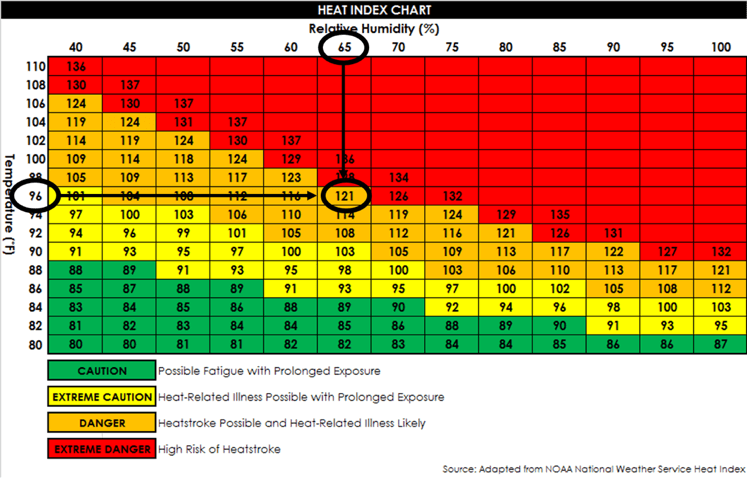
The temperature does not have to be very high for a heat-related illness to occur. And furthermore, it is paramount to understand the connection between Humidity and temperature to correctly assess working conditions.
For instance, take a look at the graph below from NOAA. You may be surprised to see how quickly the risk rises, even with only moderately high temperatures.
You may also enjoy this article.
Signs of Heat Illness
Teach your Team
It is essential for every team member to be able to spot heat-related illnesses.
You are likely already in the habit of regularly training your team on safe work practices. During the summer months, take a few minutes each day to remind your team how to keep cool and to always look out for each other.
Tip: Provide Heat Prevention related materials on job boards, such as heat index charts, posters, and simple reminders for everyone's immediate access. Furthermore, refer to these posts during training sessions.
How to identify signs of heatstroke and other heat-related ailments
It is vital that team members can identify common symptoms of heat stress and are prepared to offer basic first aid care if an episode is in progress.
Here are the most common symptoms, presented as four progressive heat-related illnesses.
1. Heat Rash
- Cause: skin irritation caused by excess sweating.
- Signs and Symptoms: rash-like irritation to the skin in certain areas, clusters of red pimples or small blisters on the neck, chest, elbow creases, groin, or at joints/skin folds.
- First Aid:
- Move to a cooler environment.
- Keep the rash area dry (wipe off or use powder).
- Avoid ointments & creams.
2. Heat Cramps
- Cause: signs of excess sweat, depletion of body salt and moisture.
- Signs and Symptoms: muscle cramps (typically in the abdomen, arms or legs, pain, spasms.
- First Aid:
- Drink water and have a snack or mix of electrolyte replacement liquid every 15-20 mins.
- Seek medical help if the worker has heart issues, a low sodium diet or if cramps do not subside within an hour.
3. Heat Exhaustion
- Cause: the body's response to excess loss of water and salt.
- Signs and Symptoms: headache & Irritability, nausea, dizziness & weakness, thirst, heavy sweating, elevated body temperature or heart rate, and decreased urine output.
- First Aid:
- Remove worker from heat
- Offer plenty of cool liquids to drink, encourage frequent sipping.
- Remove unnecessary clothing and PPE.
- Cool worker with a cold compress or wash head, face, and neck with cool water.
- Seek medical attention for evaluation and supplemental treatment.
4. Heat Stroke
Heat Stroke is the most serious heat illness; fatal if treatment is delayed.
- Cause: the body becomes unable to regulate core temperature and is unable to cool down. Can cause death or permanent disability if medical treatment is not given.
- Signs and Symptoms: sweating stops, altered mental status, confusion, slurred speech, loss of consciousness (fainting or coma), hot dry skin, seizures, and high body temperature.
- First Aid:
- Call 911 – Seek immediate medical attention.
- Remove from heat to a shaded cool area and stay with them.
- Remove outer clothing and fan down to speed cooling.
- Rinse worker with cool water, wet skin, soak clothing in cool water.
- Place cold wet cloths, ice packs or compress to the neck, head, armpits, and groin areas.
More helpful information may be found on the CDC's website here and OSHA's website here.
Team Member Wellness
It is also crucial to make sure that site supervisors understand the physical condition and underlying medical situation of teammates. Especially if they have any personal medical conditions (such as diabetes, heart failure, pre-existing conditions, etc.) that may be cause for concern.
These circumstances can exacerbate the effects of high-heat conditions.
Does the foreman and tool partner know? Again, this is a great opportunity to encourage team members to watch out for each other.
Furthermore, make sure workers are trained on site-specific emergency reporting procedures. These practices save lives.
Communication is king!
Lastly, the CDC has a couple of handy downloadable graphics for Preventing Heat-Related Illness and Symptoms of Heat-Related Illness. Download it to your mobile phone for easy access on the job!
Certain personal health risk factors can make some workers more prone to heat illness. For more information about symptoms, causes, and prevention, here is a helpful article from the Mayo Clinic.
Be Cool!
Heat Stress in Construction Environments is Avoidable
As always, being safe is good business. The minuscule cost of providing training, safe work practices, shaded break areas, and cool water on the job site, far outweighs the potential costs of a summertime illness or worse, losing a teammate.
We have teams in the field in the South, Central California Valley, and multiple projects across the U.S. This is a very familiar topic for us, and something we are very passionate about.
If you are interested in talking about the safeguards SilMan has implemented to protect our team, we would welcome that conversation anytime!
Here’s to a safe – COOL – job site!
SilMan Safety Team
About the Company
SilMan Industries (previously SilMan Construction) is based in San Leandro, Calif., with Engineering and Field Operations offices in Tupelo, Miss. The firm provides integrated turnkey solutions in the Industrial, Manufacturing, Distribution, and Public Works sectors.
Notably, in 2010 SilMan Industries was contracted to dismantle and remove the NUMMI assembly line in Fremont, Calif., transport the equipment, and reinstall the system in Blue Spring, Miss., establishing Toyota Motor Manufacturing Mississippi (TMMMS). This high-visibility project ignited the company’s meteoric growth, laying the foundation for SilMan’s national service area.
For more information, please visit www.silmanindustries.com/about.


Optimize Your Investment
SilMan’s multi-disciplinary Specialty Trade Services (STS) is a community of project professionals: Engineers, Project Managers & Coordinators, Trade Teams, and Safety Management. Bringing a new performance standard throughout the industrial community:
STS commonly supports the SilMan System Integration group. Specializations include distribution center optimization for the Fulfillment and Parcel sectors (see “A Comprehensive Guide to Efficient Parcel Handling Systems”), food and beverage manufacturing and warehouse solutions, and end-to-end innovative manufacturing solutions.
Check out SilMan’s “One Team” approach in action: Facility improvements and a new bottling line at a leading West Coast dairy.
Frequently Asked Questions for Heat Stress
What are the common symptoms of heat stress in construction workers?
Heat stress symptoms include heat rash (red clusters on skin from blocked sweat glands), heat cramps (painful muscle spasms from electrolyte loss), heat exhaustion (heavy sweating, weakness, dizziness, nausea), and heat stroke (the most severe: body temperature over 103°F, confusion, hot dry skin, seizures, or unconsciousness).
What is the critical difference between heat exhaustion and heat stroke?
Heat exhaustion is a serious heat-related illness. The worker may exhibit heavy sweating, weakness, dizziness, and nausea. Immediate action is required: move the worker to a cool, shaded area, offer cool liquids, and remove unnecessary clothing. Heat stroke is a life-threatening medical emergency. The body loses its ability to cool down; signs include confusion, slurred speech, loss of consciousness, or hot, dry skin (sweating may stop). Call 911 immediately and begin aggressive cooling (ice packs, wet cloths) until help arrives.
How often should construction workers take water breaks to prevent dehydration?
To maintain proper hydration and prevent heat illness, workers should be encouraged to drink at least one cup (8 oz.) of cool water every 15 to 20 minutes, even if they do not feel thirsty. Workers should be advised to consume electrolyte-replacement liquids during long shifts or when performing high-intensity work.
What is heat acclimatization, and why is it important for new employees?
Heat acclimatization is the gradual increase in a worker's tolerance for working in hot conditions over 7 to 14 days. This is crucial because a high percentage of heat fatalities occur during a worker's first week. Best practice, often called the "20% Rule," is to limit new or unacclimatized workers to 20% of the shift duration at full intensity on the first day. Then increase exposure by no more than 20% each subsequent day. It can take 7-14 days for workers to become fully acclimatized.