Warehouse Automation Systems
4 Steps to Future-Proof Your Facility

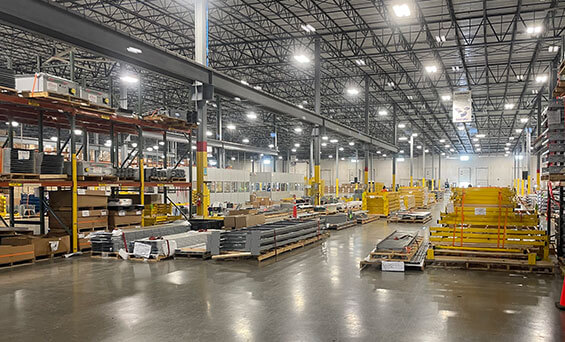
The adoption of warehouse automation systems for companies across the U.S. is no longer a choice. Investing in automation systems is now a business imperative for success. The convergence of increased volume, heightened competition, and the accessibility of technological solutions means that fulfillment and distribution providers are shifting their long-term investment decisions to the near term to remain competitive. Automated warehouse solutions, however, can cause confusion, or worse yet, inaction. The following article offers four steps for a cost-effective pathway toward incremental adoption of technology: Leadership, Imagination, Strategic Investment, and a fresh look at ROI justification.
Keeping Up with Tech
Remember One Thing About Warehouse Automation Investment
We have all been through the cycle: we invest in new technologies that become outdated long before we recognize an acceptable return. Many have justifiably become reticent to update equipment technology.
But that won’t work this time.
There is no escaping the fact that the age of technological evolution is upon us, and the entire material handling sector is hurtling toward solutions that were once the stuff of science fiction just a few years ago.
The data is clear. The world of distribution and fulfillment is changing, and there is no mercy for those operators who fail to adapt to the inevitable transformation of their operations.
In response, each of us needs a roadmap for the long-term, cost-effective adoption of technological change. Moving forward without a plan could initiate an irreversible spiral, ultimately increasing the cost of future investments.
Investment in Automation: Remember this One Thing
In this article, we will help you get started on the path toward efficiency, reduced costs, and increased competitiveness.
In each of the four sections that follow, we will focus on actionable strategies that can benefit you today, tomorrow, and beyond.
With the varied experiences of our System Integration team, there is one truism we have seen over and over:
You don’t have to be ahead of the curve, just be on it.
In other words, you don’t need to invest at the speed of technology, but you do need to plan at the speed of technology. Without an investment strategy to implement change, you risk falling behind, which increases the costs of catching up, ultimately diminishing profitability and competitiveness.

1. Build the Team
United Leadership is the Core of Warehouse Automation Success
Here we are at the gateway of a new era, and I am sure you have heard the buzzwords:
- Industry 4.0
- VR
- AR
- IIOT
And while a lot of people are talking about these things, very few are offering strategies to deploy today in a realistic, cost-effective way.
What should I do first?
Let’s start with what is NOT your next step: you do not need to make a massive capital investment in completely new warehouse automation systems.
It’s much more important right now to have a consensus among your leadership team about where you are today:
- Pull your key stakeholders together.
- Seek a clear picture of future opportunities and the competitive landscape
- Ask difficult questions about the effectiveness of your current operation and levels of technology.
- And be okay with the fact that you don’t have all the answers!
The buy-in of your entire team is the core of your future success, and a great first step forward.
2. From Automation to Imagination
Warehouse Innovation Begins Redefined Outcomes
Now your team is now fully engaged and shares a united understanding of the current state of your operation.
After all of the investigation and number crunching, let’s change gears, tune in to our left brain, and think again about your facility.
Looking into the future requires that you see your organization as a blank slate.
By doing this, we move from “automation” to “imagination.”
New Horizons for Your Warehouse Automation System and Facility
With your newly emptied facility, you are ready to view your business through the prism of 21st-century solutions.
You are also ready to ask the most important question of our times: “What if?”
- What if I re-build my process in a completely different way?
- What if I entirely change the flow of material through my plant?
- And what if these innovations can generate tremendous previously unseen opportunities?!
Let’s see how technical innovation and imagination can work together in practice.
Automation Possibilities: Modularity
Automation today is increasingly modular.
This opens up new worlds of what your space looks like, and what it can do.
The existing footprint of your plant is not etched in stone. What else is possible given the physical space and your team’s capabilities.
Modular equipment is easier and more cost-effective to install and offers more flexibility than previous automation hardware.
Or, what if products that are not even part of your current output could be serviced with the same equipment in a new configuration?
The point is: by understanding the capabilities of new technologies, we expand our ability to re-imagine our system and facility.
You may also enjoy this article.
3. Smart Money
Warehouse Automation Investment: Repair or Replace
Every day our team members speak with clients who are trying to save money.
While reducing expenses is a central part of system integration, there is more to profitability than simply cutting costs.
The question we need to ask is: are we chasing cost savings at the expense of increased efficiency and future benefits?
In reality, the smart way forward lies somewhere in the middle.
To achieve this goal, we need to talk about “Smart Money.” That is, spending money to make money instead of endlessly repairing legacy gear to save money.
Let’s take a look at how this model works with a real-life analysis of a strategy that you could deploy today.
Automation Possibilities: The Industrial Internet of Things (IIOT)
IIOT is the “Industrial Internet of Things” and it lies at the heart of warehouse automation systems.
The internet travels through your facility on Ethernet and which has become the backbone of modern industrial communication. Everything on your future production floor will be directed over ethernet.
In fact, all of the devices coming into the market today – HMI, smart sensors, PLC – items we have been using for years – are all designed to be connected over a single network, talking to each other.
Proactive Maintenance
Imagine a conveyor with a motor and vibration sensors. In the past, predictive maintenance on this equipment was very difficult.
And of course, the motor inevitably goes out on the busiest day of your busiest season!
Not anymore.
With IIOT you can receive a steady flow of information about the health of every device in your system, allowing you to closely monitor your equipment in real-time.
Not only does IIOT have a relatively low buy-in, but it can also lay the groundwork for incremental performance improvements in the short term, and can expand with every future equipment upgrade.
Now that’s smart money!
And it’s one more way you can stay on the technology curve, instead of falling behind.
The Big Picture
One more thing to keep in mind as a senior leader: this is not just about warehouse automation systems, equipment, and software.
Consider how this kind of “future-forward” thinking can positively impact your team culture, recruiting, marketing, and future sales?
4. Functional ROI
A Fresh Look at Investment Justification
We’ve built our team, we’ve imagined a new future, and we have selected a tech-savvy path forward.
But eventually, we will need to justify our ideas for approval.
Let’s talk about a new way to get the green light from decision-makers.
What is it really worth?
While ROI is the accepted standard to evaluate an investment, there are limitations to its application. Furthermore, as the complexity of business expands so does the variety of developments of the concept.
For instance, what do we define as “return?”
As mentioned earlier, technological advancement begs us to set aside our current understandings, and use Industry 4.0 concepts to re-imagine our operation.
The same is true for our accounting methods.
What if you looked at your long-term viability and future revenue and you ask yourself,
“Is the investment going to garner new business?”
“Will the improvements deepen customer loyalty?
“Improved efficiency, faster throughput, fewer touches?”
The answer to all three, of course, is “Yes!”
If you didn’t believe the solution would advance your operation, you wouldn’t be making the investment in the first place.
While not commonly considered with a standard ROI analysis, these concepts are all quantifiable numbers that should be considered when assessing the value of capital expenditures.
This is a paradigm shift. We could call it Functional ROI. And adopting language like this can be revolutionary.
Implementing future-focused solutions will make you more competitive, more efficient, and more profitable, allowing you to expand your client base and product portfolio, and even make you a greener company.
But are you accounting for them in your assessment of expenditures? The layout of cash is not the only measurement of value.
The numbers may be a little tougher to establish, but well worth consideration.

Putting it All Together
You are Not Alone
This is a great time to reach out to SilMan’s Integration Professionals. Our team has a demonstrated history of employing these technologies and is committed to building relationships, understanding its clients’ business goals, and delivering beyond expectations.
Let’s get to know each other a little better, and we guarantee there is a smart “right move” you can execute today.
However, despite the urge to “catch up” we all know how fast the latest innovation can be eclipsed. None of us can afford to continually replace technology.
Therefore, you need a plan to protect your investment and set your operation on a course toward achievable advancements and that will incrementally stabilize your ongoing competitiveness.
And that takes us full circle: you don’t need to be in front of the technology curve, just be on it.
Future-Proof your Investment
Warehouse Automation Systems in the Real World
What is your facility going to look like in 10 years?
One thing is for sure, it will not look like it does today!
Getting your team on the same page and applying your imagination to understand horizon technologies is a great place to start.
However, despite the urge to “catch up” we all know how fast the latest innovation can be eclipsed. None of us can afford to continually replace technology.
Therefore, you need a plan to protect your investment and set your operation on a course toward achievable advancements, and that will incrementally stabilize your ongoing competitiveness.
And that takes us full circle: you don’t need to be at the forefront of the technology curve, just on it.
About SilMan Industries
SilMan Industries (formerly SilMan Construction) is based in San Leandro, California, with Engineering and Field Operations offices in Tupelo, Mississippi. The firm provides integrated turnkey solutions in the Industrial, Manufacturing, Distribution, and Public Works sectors.
Notably, in 2010, SilMan Industries was contracted to dismantle and transport the NUMMI assembly line in Fremont, Calif., transport the equipment, and reinstall the system in Blue Springs, Miss., establishing Toyota Motor Manufacturing Mississippi (TMMMS). This high-visibility project ignited the company’s meteoric growth, laying the foundation for SilMan’s national service area.
For more information, please visit www.silmanindustries.com/about.

Integrated Material Handling Solutions
The SilMan System Integration team provides conveyor equipment and automation solutions to industry-leading companies in multiple sectors across the US. The company has built this reputation on the unique insight and value delivered on every project. These outcomes begin with a deep understanding of overarching business objectives, enabling the identification of the highest-value course of action. Specializations include distribution center optimization for the Fulfillment and Parcel sectors (see “A Comprehensive Guide to Efficient Parcel Handling Systems”), food and beverage manufacturing, warehouse solutions, and end-to-end innovative manufacturing solutions.
Frequently Asked Questions for Warehouse Automation Systems
How do you calculate the ROI of a warehouse automation system?
To calculate warehouse automation ROI, subtract the total cost of ownership (TCO)—including hardware, software, and maintenance—from the total annual savings in labor, space optimization, and error reduction. Most facilities achieve a full return on investment within 18 to 36 months, significantly accelerating as throughput volume increases.
What are the most critical factors when investing in warehouse automation?
The most critical factors are system scalability, integration compatibility with existing Warehouse Management Systems (WMS), and your facility's specific throughput requirements. Prioritizing modular solutions, such as Autonomous Mobile Robots (AMRs), ensures your investment can expand alongside your business growth without requiring a complete system overhaul.
How can I future-proof my warehouse automation investment?
Future-proof your investment by selecting vendor-agnostic software and modular hardware that supports easy upgrades. Implementing AI-driven analytics and ensuring your automation can handle seasonal SKU proliferation allows your facility to remain efficient and competitive as technological trends and market demands shift.
What is Functional ROI?
Functional ROI includes Industry 4.0 concepts to reimagine and expand upon the traditional definition of ROI in accounting. Functional ROI considers if the investment will garner new business, deepen customer loyalty, and/or improve efficiency, faster throughput, and require fewer touches. While not commonly considered with a standard ROI analysis, these concepts are all quantifiable numbers that should be considered when assessing the value of capital expenditures.