Conveyor System Safety
Robust Conveyor Safety Standards Needed
Material handling systems play a crucial role in the smooth operation of modern supply chains. From manufacturing plants to distribution centers and fulfillment warehouses, these intricate networks of conveyors, sorters, and automated equipment ensure that goods are efficiently moved, processed, and shipped to their final destinations. As businesses strive to meet the ever-increasing demands for speed, the importance of material handling systems will continue to expand.
However, the growing reliance on these systems comes with an increased need for robust safety practices. As the volume of goods handled increases and the speed at which they are operated accelerates, the potential for accidents and injuries also grows. Moreover, the ubiquity of material handling systems across various industries means that a wide range of workers, from skilled technicians to frontline operators, are exposed to the hazards associated with these complex machines.
SilMan Material Handling System Integration and Specialty Trade Services teams are deeply experienced in working with conveyor systems. In this article, we will draw on our intimate experience creating safety programs for our teammates and discuss the specific types of hazards and the most common countermeasures, preventions, and controls presented by conveyance equipment. We will also explore how all of us can prepare our teams to work safely in material handling facilities.
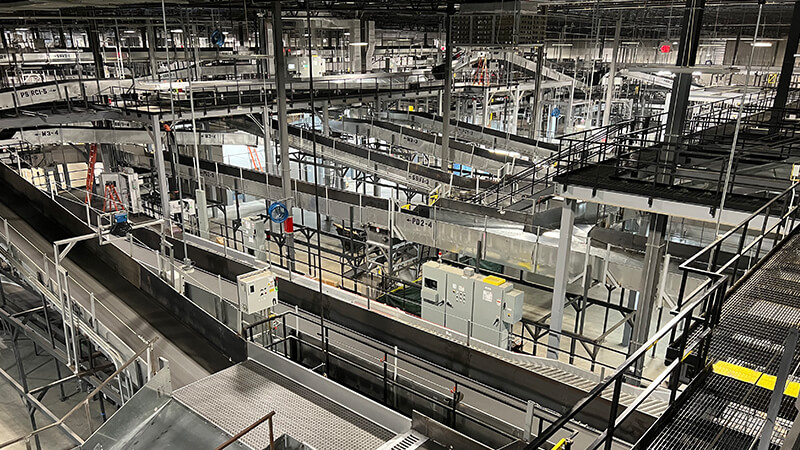
Modern Conveyor Systems create complicated workplaces, with potential hazards around every corner.
Hazards in Operational Conveyor Systems
Once a conveyor system is properly installed and fully operational, a specific set of hazards is introduced to the facility. To ensure safety during normal operation and maintenance facilities must employ various safeguards and procedures.
When interacting with any unfamiliar conveyor apparatus, workers and managers must carefully identify (assess) potential hazards like slips/falls, falling objects, exposed rotating parts/shafts, entanglement/entrapment, and pinch points. Areas under overhead conveyors often utilize safety nets to mitigate falling-object risks, and machine guarding to prevent entanglement hazards. In addition, conveyors should be riddled with warning labels and signage, highlighting danger zones or areas along the conveyor that may be hazardous.
Perimeter Safety
Overhead Conveyors require dedicated fall protection like guard rails and hi-grip access ladders. Ground-level conveyors necessitate visual warnings, physical barriers (guards/fencing), crossover bridges, or path re-routing to prevent accidental injury.
Stored Energy – “Safe-Off” Methods
Conveyors in operation inherently have powered energy sources that can cause harm to front-line workers and maintenance personnel. Facilities primarily use two methods for safely shutting down conveyor systems: e-stops and lockouts.
- E-stops are “emergency” pushbuttons or pull chains that trigger a temporary full-system stoppage. Though the e-stoppage is temporary, more modern e-stops also contain a lock-out tab that allows front-line workers and maintenance crews to apply personal locks/tags which prevents the system from restarting until the crew’s lock is removed and e-stop reset.
- Lock-outs (a.k.a. LOTO) sectionally power down the system along a conveyor line and must be engaged/disengaged manually. Primary control lock-out points are typically located at motor-drive disconnects and control panel switches that are staged along the length of most conveyor lines. Proper LOTO prevents anyone from unintentionally restarting the system where crews may be working.
Crushing and Entrapment
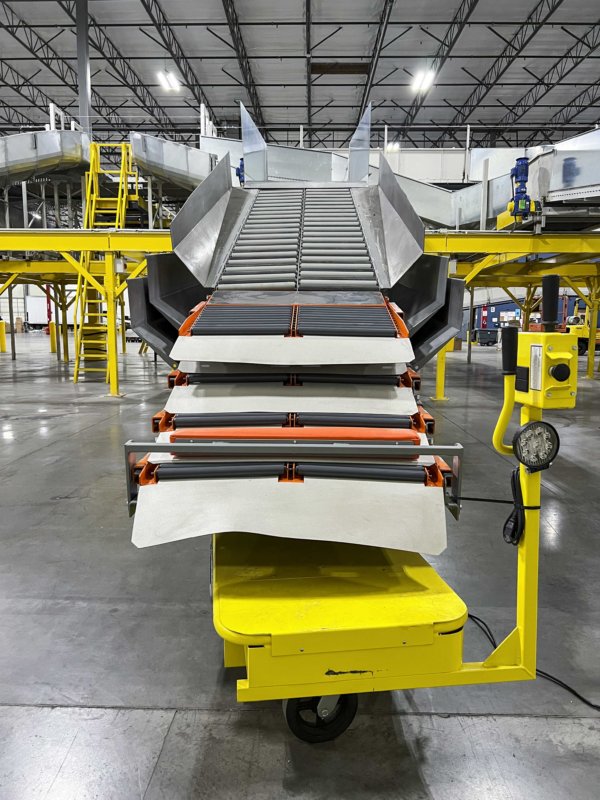
Fulfillment operators and dock receivers must stand back from the trailer while extendable conveyors are advancing/retracting. Extendables can crush or trap unaware workers against pallets and products/shelving while they are inside the trailer. Often trailers don’t have rear lighting either, so workers may be hard to see, therefore anyone operating an extendable conveyor must clear the trailer of all personnel before operating.
Exposed Moving Parts
All potentially hazardous moving parts, like chains, gears, and belts, should receive physical machine guards. Guards must remain fixed in place during operation.
Injury Potential from Slow-Moving Conveyors
While conveyors move at relatively low speeds compared to equipment like forklifts, their power still enables severe crushing and entanglement/entrapment. Workers must receive training to avoid directly contacting belts and exposed parts or gears/chains, rotating shafts, rubber belts, and rollers, even when they appear harmless.
Simply standing on a conveyor or jumping over them poses serious risks. Workers must remain off conveyors at all times unless it is fully locked out.
Configuration, Size, and Function
Depending on configuration factors like size, incline, speed, power source, and shape conveyors pose different risks. For example, inclined gravity chutes rely on slick surfaces to transport materials, presenting obvious slip-and-fall risk to workers. Powered conveyors introduce amputation and entrapment hazards from moving parts. Overhead conveyors pose falling-product hazards, entanglement risks, and head bumps.
Extendable Conveyor Safety
In facilities with truck trailers and shipping bays, extendable conveyors that bridge the gap between building and vehicle require unique safety considerations.
Workers should receive training on the proper operation of extendable conveyors and exercise extreme caution when traversing between the trailer and the building dock.
Trip/Fall Hazards Between Dock and Trailer
Bridges linking extendable conveyor systems into trailers can pose fall hazards from dock gaps/openings, or trip hazards from bridge gaps, ramp height differences, and low lighting issues.
Ergonomic Concerns
The use of Extendable Conveyors (ECs) in the first place is designed to help reduce ergonomic issues for dock workers, by eliminating the need to use pallet jacks and forklifts, while also shortening the distance between palleted product and trailer loading.
ECs reduce risks from carrying products by hand and eliminate the potential of tripping/falling over the dock bridge/gaps. ECs bring products deep inside the trailer’s drop-off/or removal point. Just the function of loading and unloading goods (by hand) to and from trucks introduces ergonomic hazards associated with repetitive heavy lifting.
Even with ECs, workers should continually utilize proper lifting mechanics, request assistance when needed, and take regular breaks. Facilities aim to minimize lifting requirements through height-adjustable loading bays or the assistance of mechanical lifting devices/equipment
Conveyor and Maintenance
Before any repair work or manual adjustments occur, proper LOTO procedures confirm the deactivation of all necessary powered systems. Once repairs are made, testing and calibration are normally required with the system running, but should only be performed under strictly controlled conditions with proper training and safeguards in place.
By understanding and addressing these hazards, teams can work safely and efficiently with completed conveyor systems. Regular training, clear communication, and a commitment to following established safety procedures are essential to maintaining a secure working environment and preventing accidents or injuries.
You may also enjoy this article.

Conveyor System Policy and Practice
Every conveyor process presents unique configurations and safety challenges. Workers tasked with manual duties like loading, unloading, assembly, and quality checks should receive specialized training and protocols for their particular role to prevent injuries.
Keep your eyes on the fundamentals of best practices for team members working near material equipment, by monitoring and enforcing clothing and grooming guidelines, including:
- Tuck in or remove loose clothing and jewelry or any dangling accessories
- Long hair must be tied back, put in a bun or hat
In the end, all industrial businesses must view worker safety as the top-most single priority. Regarding safety policies, conveyor systems and related equipment introduce unique hazards, due to the power and speed at which they operate. We hope that by sharing our experience working with these systems, we can play a part in supporting the well-being of your employees.
No amount of production efficiency or throughput time overrides the fundamental need to ensure that all team members return home unharmed every day. A shared commitment to safety and consistent messaging can encourage accountability at all levels and provide the best insurance against injuries or worse.
About SilMan Industries
SilMan Industries (formerly SilMan Construction) is based in San Leandro, California, with Engineering and Field Operations offices in Tupelo, Mississippi. The firm provides integrated turnkey solutions in the Industrial, Manufacturing, Distribution, and Public Works sectors.
Notably, in 2010, SilMan Industries was contracted to decommission and dismantle the NUMMI assembly line in Fremont, California, transport the equipment, and reinstall the system in Blue Springs, Mississippi, establishing Toyota Motor Manufacturing Mississippi (TMMMS). This high-visibility project ignited the company’s meteoric growth, laying the foundation for SilMan’s national service area.
For more information, please visit www.silmanindustries.com/about.

Optimize Your Investment
SilMan’s multi-disciplinary Specialty Trade Services (STS) is a community of project professionals: Engineers, Project Managers & Coordinators, Trade Teams, and Safety Management. Bringing a new performance standard throughout the industrial community:
STS commonly supports the SilMan System Integration group. Specializations include distribution center optimization for the Fulfillment and Parcel sectors (see “A Comprehensive Guide to Efficient Parcel Handling Systems”), food and beverage manufacturing and warehouse solutions, and end-to-end innovative manufacturing solutions.
Check out SilMan’s “One Team” approach in action: Facility improvements and a new bottling line at a leading West Coast dairy.
Frequently Asked Questions for Conveyor Safety
What is the difference between an E-Stop and LOTO for conveyor systems?
An E-Stop (Emergency Stop) is used for a quick, temporary halt of system operation in an emergency, but often leaves control power energized. LOTO (Lock-out/Tag-out) is a formal, sectional procedure to de-energize and lock the primary power source to rule out any possibility of the system restarting during maintenance or repairs.
Where are the most common pinch and entrapment points on a conveyor?
The most common pinch points are where the conveyor belts wrap around rollers, near drive motors and chains, and where the system passes through walls or floors. To keep personnel safe around these areas, they must be protected by fixed machine guards or physical barriers to prevent entanglement.
What is the critical safety rule for operating extendable conveyors in a trailer?
The critical rule is that all personnel must be cleared from the trailer before advancing or retracting the extendable conveyor. Extendables can crush or trap unaware workers against pallets and shelving, therefore a clearance verification is mandatory before operation.
What are the main OSHA conveyor hazards, and how can they be prevented?
OSHA identifies key conveyor hazards under 29 CFR 1910.212, including entanglement in moving parts, pinch points that can cause crushing injuries, and falls from slips or falling objects. Prevention starts with machine guarding, such as barriers around nip points and exposed rollers, and perimeter safety like guardrails. Facilities must implement emergency stops (e-stops) and lockout/tagout (LOTO) for maintenance. Regular hazard assessments and worker training on these risks reduce incidents by up to 70%, per OSHA data. For extendable conveyors, fall protection nets are added and workers participate in ergonomic training to avoid trips in loading bays.