Best Practices for Rigging and Relocation Safety

Decommission and demolition of an automotive manufacturing plant (Photo Credit: SilMan Industries)
Summary:
In this article, readers will explore rigging and relocation safety as practised by SilMan’s Specialty Trade Services. We will share the strategies and operations employed by our very own safety managers to keep rigging and relocation teams safe.
Additionally, we have included a copy of our Safe-Lift Plan Checklist created by SilMan’s Safety Team.
Rigging and Relocation Safety
SilMan Industries enjoys productive relationships with market-leading enterprises in parcel, fulfillment, automotive, food and beverage, manufacturing, and public works.
While there are many specialized skills deployed in each of these environments, they all share one thing: the equipment will inevitably be moved.
Lifting and moving large equipment is a core aspect of the Millwright trade, and has the potential to expose the rigging team and plant personnel to grave danger, and can cause serious damage to facilities and equipment.
In response, the rigging trade has very specialized protocols to ensure the well-being of team members and the protection of capital assets.
Learn from the Pros
Planning & Collaboration in High-Risk Environments
Safety lies at the heart of daily life at SilMan. Worksite safety is baked into our system, with the safety team involved with every project long before boots hit the ground.
Given their deep experience and the high-risk nature of rigging and moving machinery, we have turned to our Safety Team to share their expertise with the world.
In this spirit of community, here is a synopsis of rigging and relocation safety at SilMan Industries.
Preplanning and Team Coordination are Vital to Rigging Success
As with all serious undertakings, a rigging and relocation project begins long before a crane is delivered and the execution team arrives at the job site.
Scott Harding, who leads SilMan’s safety efforts, says:
“Our SOP for a rigging project has two phases:
First, project leadership collaborates with safety on extensive pre-planning, which includes defining the scope of work, proper hoisting equipment needed, and completion of a Jobsite Hazard Analysis (JHA) and Lift Plan.
Secondly, of course, our safety team is present when our project execution team arrives onsite with all the necessary rigging tools and sets the stage for mobilization. Throughout each day of the project, day, the team is routinely gathered to review our Safe Lift Plan.”
Two Phases of Rigging Safety
1. Develop the Safe Pick Plan
Preplanning and Coordination are Vital to Rigging Success
The Safety Team is closely involved with our Rigging experts to create a Safe Pick Plan, also known in the industry as “Lift Plan”.
The objectives of this process are to understand load weights, determine the size of crane and rigging equipment, training personnel, and the mitigation of any environmental hazards.
An adequate Lift Plan includes seven core elements:
- General Project Information
- Equipment/ Load Review
- Heaviest load(s) to be moved (size/ weight dependent) including its center of gravity
- Crane size, type, and rigging configurations necessary to hoist such load(s) including Critical Lift criteria (if exists)
- Environmental Conditions – list all known site hazards
- Communication Methods – hand signals and two-way radios
- Load Control Methods – hands-free tag lines/hooks
- Sketch / Image of Crane Placement – birds eye satellite view showing the direction of travel, boom radius, and height.
- Qualified Rigging Team Meeting and Acceptance

Rigging team working with a crane to manage a large silo while cribbing is prepared for placing the unit on ground transport (Photo credit: SilMan Industries).
Create a Jobsite Hazard Analysis
The Jobsite Hazard Analysis, or JHA, is one of the most important contributions that a safety officer brings to the project management process. The JHA addresses each hazard, including countermeasures and as many alternative precautionary methods as possible.
For each risk, we practice the standard “Hierarchy of Controls” in order for us to navigate the best precautionary options to protect all parties involved in this type of operation.
In the case of rigging and relocation, the JHA goes beyond simply having a Lift Plan.
The JHA identifies all known risks involved in the project, before during, and after the lift. The process produces a report detailing all hazards and prevention techniques involved with each separate task.
Let’s review the most common risks and remedies associated with rigging and relocation and how the JHA risk assessment thought process works.
Environmental Risks
Examples of everyday environmental hazards the rigging team may face are – inclement weather, weak foundations, slopes/ramps, pedestrian and vehicle traffic, slips/trips, noise, dust, hot work, heat, and COVID-19.
Clearance
It is vital to understand the area surrounding the lift area and the travel path of the equipment being moved.
For instance, will any lifts take place over the top of human activities or over a production line inside the plant? Are there any clearance issues along our path of travel?
Going a little wider, we look for nearby elements such as overhead power lines, radio antennas, trees, and structural protrusions. For instance, will the lift involve passing over the top of a building? Could it interrupt an airport one mile away?
Communication
The ability of all team members to have full sight of the status of the mobilization is a critical part of a safe lift.
The Lift Supervisor, Crane Operator, and Crane Signaler must be in direct communication, either visually and/or by radio. Some physical obstructions could disturb radio clarity, which must be determined in the assessment phase.
Danger Zone
Despite how obvious it sounds, ground barricades and posted signage around the crane or other lifting equipment are fundamental visual communication for the crew and any other persons in the area to understand that risk is present.
Furthermore, visual communication with the Rigger team by safety borders around the crane and lift areas is essential.
These clearly marked areas may convey the threat of falling debris or indicate where team members may clearly hear the “All Clear” when the lift begins.
Other Hazards
The Rigging Crew faces numberless risks within or around a lift zone far beyond the scope of this article. Here are examples of additional risks encountered.
- Getting struck by, caught between, or underneath a potentially falling load
- Shifting/falling parts while dismantling the equipment
- Fall hazards during catwalk or rooftop work, or in a pit create which is exposed when machinery is removed
- Sudden equipment shock-loading or load-shifting that could unintentionally pin/crush team members
Not only do these precautions apply to the lift, but to the entire journey through the facility and on to the target land transport awaiting outside.
2. Project Execution
Minute-by-minute teamwork and communication
The planning is complete and our safety managers have joined the rigging crew onsite. A JHA and lift plan alone will not suffice. These projects require the practiced eye of a professional safety manager and qualified and experienced Riggers.
The pick day begins with a team discussion in which the JHA and the Safe Lift Plan are reviewed and approved.
The basic elements of a safe rigging execution project are as follows:
- Equipment ready for the move: Decommission completed (electrical disconnected, fluids drained, detached from floor anchors, etc.), equipment is prepared and ready for lift and transport
- Plan review: The rigging team reviews and signs the JHA and Lift Plan
- Riggers safely inspect and install rigging and tag lines then prep equipment for mobilization, securing all loose items, ductwork, cables, etc.
- Crane is staged, oiled, and inspected
- Horn is blown – equipment and team is ready to lift
Once the individual piece is prepped and rigged, the Crane Operator and Lift Supervisor confirm readiness and all communication channels are in place.
The Lift
Spotters confirm clear passage for the elevated machinery and provide caution to others along the way.
Barricades are placed around the hoisting operation for visual awareness to stay clear.
All team members assume positions away from the unit being moved, a horn is sounded, and the crane begins its work.
Finally, the piece is safely landed and secured to on-ground cribbing, or directly onto a transport vehicle. Cribbing protects equipment from touching the ground for employee protection and allows forklifts to be placed under the load.

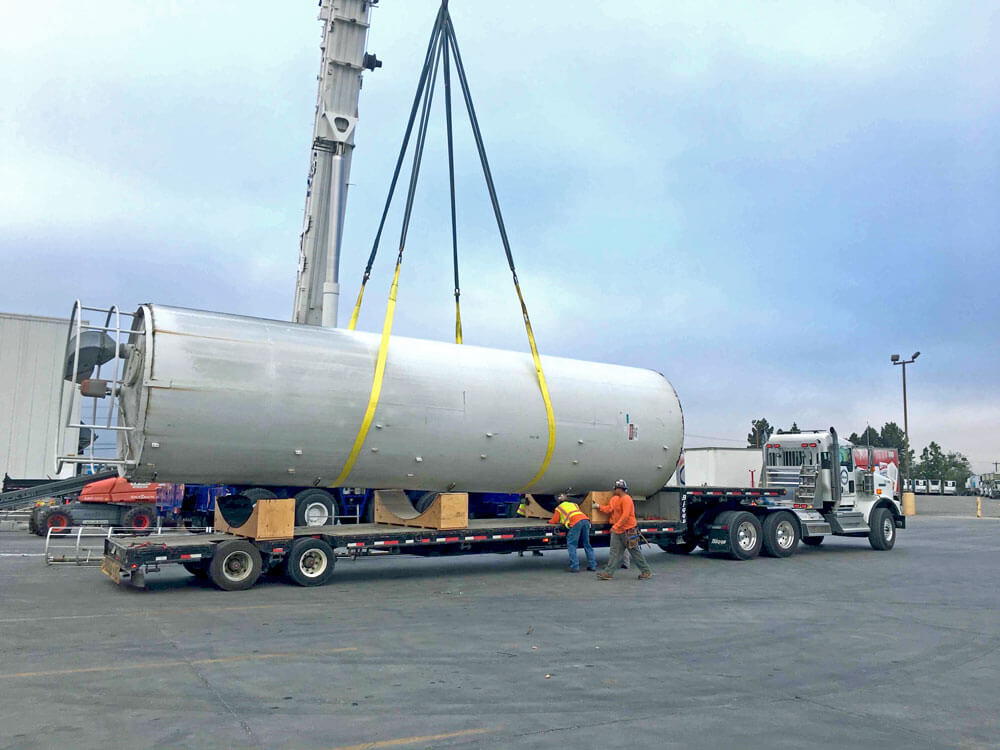
Silos placed on land and transport “cribbing” from beverage facility rigging and relocation projects. (Photo credit: SilMan Industries)
Real-world Tools
Once again, Scott Harding:
“There are many aspects to be considered in a Safe Lift Plan. The SilMan Safety Team has created checklist to guide our work and I would like to share it with you.
Successful Rigging Projects Begin with Safety
Preparation and coordination saves lives and protects property
We will turn to Scott Harding one more time to summarize the rigging and relocation safety concept shared in this article.
“As always, safety is good business. It protects the well-being of team members, and shields companies from unnecessary expenses.
Rigging and relocation projects are highly hazardous undertakings and require immense planning.
Using a JHA and Safe Lift Plan greatly supports management and rigging crews to plan for all of the foreseeable concerns on site. If all of the existing and potential hazards are considered well in advance, there should be no reason for an unsafe pick.
Capturing all of the risks involved and planning out all the requirements early on is paramount. Using preformatted Lift Plan and JHA templates helps speed up the process and allows safety management and rigging crews to plan around all of the foreseeable concerns on site.
In the end, however, rigging is slow, patient work. Embrace the system. Safety is embedded into every step.
Teamwork and highly detailed attention to the execution of the Lift Plan will set the stage for a successful relocation of any size and nature.”
About SilMan Industries
SilMan Industries (formerly SilMan Construction) is based in San Leandro, California, with Engineering and Field Operations offices in Tupelo, Mississippi. The firm provides integrated turnkey solutions in the Industrial, Manufacturing, Distribution, and Public Works sectors.
Notably, in 2010, SilMan Industries was contracted to dismantle and transport the NUMMI assembly line in Fremont, Calif., transport the equipment, and reinstall the system in Blue Springs, Miss., establishing Toyota Motor Manufacturing Mississippi (TMMMS). This high-visibility project ignited the company’s meteoric growth, laying the foundation for SilMan’s national service area.
For more information, please visit www.silmanindustries.com/about.

Optimize Your Investment
SilMan’s multi-disciplinary Specialty Trade Services (STS) is a community of project professionals: Engineers, Project Managers & Coordinators, Trade Teams, and Safety Management. Bringing a new performance standard throughout the industrial community:
STS commonly supports the SilMan System Integration group. Specializations include distribution center optimization for the Fulfillment and Parcel sectors (see “A Comprehensive Guide to Efficient Parcel Handling Systems”), food and beverage manufacturing and warehouse solutions, and end-to-end innovative manufacturing solutions.
Check out SilMan’s “One Team” approach in action: Facility improvements and a new bottling line at a leading West Coast dairy.
Frequently Asked Questions for Rigging and Relocation Safety
What are the seven core elements required for a Safe Lift Plan?
A comprehensive Safe Lift Plan (or Lift Plan) must include:
- General Project Information (Scope of work).
- Equipment/Load Review (size, weight, and center of gravity).
- Crane & Rigging Configurations (including Critical Lift criteria).
- Environmental Conditions (known site hazards).
- Communication Methods (hand signals and radios).
- Load Control Methods (hands-free tag lines/hooks).
- Sketch/Image of crane placement (boom radius, height, and travel path).
What is the primary difference between a Lift Plan and a Jobsite Hazard Analysis (JHA)?
The Lift Plan is a procedural document focused specifically on the technical requirements for safely hoisting a load. The Jobsite Hazard Analysis (JHA) is a broader risk assessment that identifies all known risks involved in the entire project—before, during, and after the lift—and details precautionary methods for each task using the Hierarchy of Controls.
What safety measures ensure safe execution during equipment relocation?
To ensure safe equipment relocation, it's crucial to inspect all rigging and cranes pre-lift. In addition, position teams outside swing radii, use spotters for guidance, and signal lifts with horns. Maintain barricades, employ tag lines for control, and land loads on protective cribbing. Emphasize slow, coordinated movements and maintain constant communication to avoid overloads or shifts.
What is industrial cribbing, and why is it used during heavy equipment relocation?
Industrial cribbing refers to stacked, interlocking blocks or timbers used to temporarily support heavy loads or equipment. It is essential during relocation to:
- Support the load after the lift is complete.
- Protect the equipment from direct contact with the ground.
- Create clearance for forklifts or rollers to be placed underneath the load for transport.